Dactylic Hexameter Syllable Counting and Scansion Formula: Quantitative Meter Guide
Analyzing classical epic poetry in Latin and Ancient Greek requires mastering the dactylic hexameter syllable counting formula to decode how variable metrical substitutions govern line length. In modern accentual-syllabic verse (such as English iambic pentameter), lines typically maintain a strict, fixed syllable count (such as 10 syllables per line). In contrast, classical dactylic hexameter is a quantitative metrical system governed by moraic duration (vowel quantity) rather than word stress, allowing line syllable counts to fluctuate dynamically between 12 and 17 syllables.
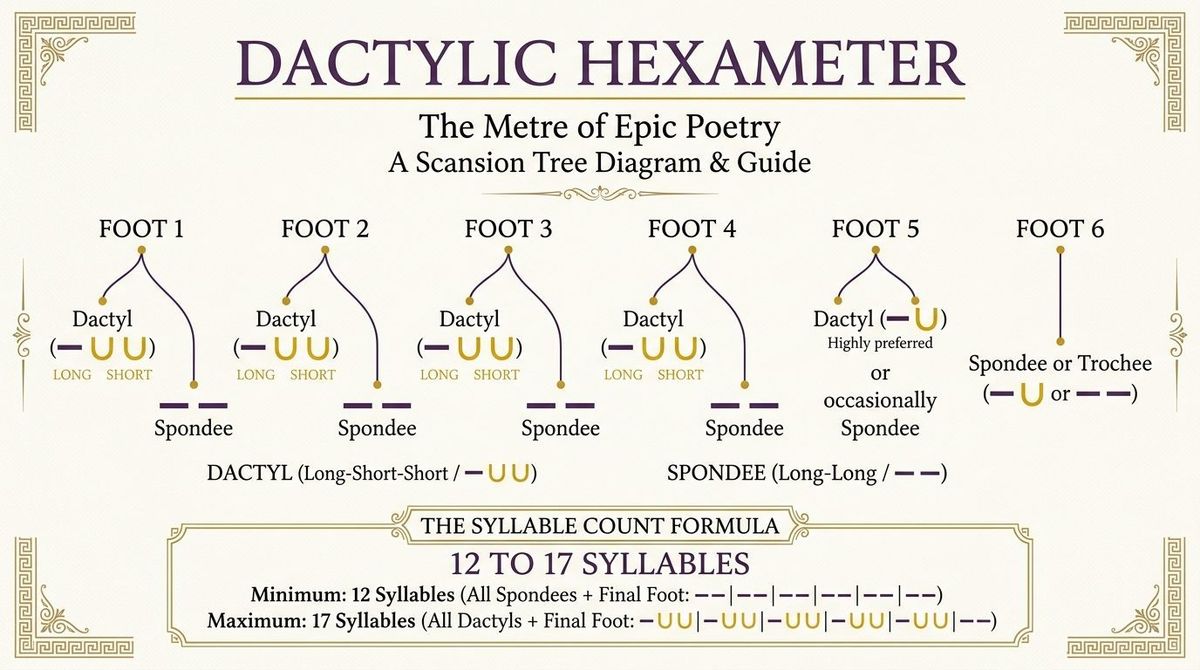
From Homer's Iliad and Odyssey to Virgil's Aeneid and Ovid's Metamorphoses, the hexameter line consists of six metrical feet. The poetic rhythm derives from the interplay between dactyls (one long syllable followed by two short syllables: \(-\ \cup\ \cup\)) and substituted spondees (two long syllables: \(-\ -\)). Calculating the exact syllable count of an epic verse requires determining where spondees replace dactyls and identifying phonetic boundary phenomena including elision, synizesis, and epic correption.
Metrical Scansion Key Takeaways
- Dynamic Syllable Count (12 to 17 Syllables): Because each substituted spondee contracts two short syllables into one long syllable, a valid hexameter line can contain anywhere from 12 syllables (holospondaic) to 17 syllables (holodactylic).
- The Fixed Sixth Foot (Anceps): The final sixth foot never contains a full three-syllable dactyl; it is always a disyllabic foot ending with a long syllable followed by an anceps (\(-\ \underline{\cup}\)).
- Dactylic Preference in Foot 5: Foot 5 is overwhelmingly a dactyl (\(-\ \cup\ \cup\)); spondaic fifth feet (producing a versus spondaicus) occur in fewer than 4% of classical epic lines.
- Caesura Governs Rhetorical Pause: Lines are split metrically by a caesura (word break within a metrical foot), most frequently after the first syllable of the third foot (masculine caesura).
The Quantitative Anatomy of the Hexameter Line
Classical Greek and Latin prosody measures poetic rhythm in temporal units called morae. A short syllable (\(\cup\)) possesses a duration of one mora, while a long syllable (\(-\)) possesses a duration of two morae. A standard dactylic foot consists of four morae:
Because a spondee matches the identical temporal duration of a dactyl (4 morae), Roman and Greek poets substituted spondees freely into the first four feet of the hexameter to alter narrative pacing—hastening dramatic action with rapid dactyls or conveying somber gravitas with heavy spondees.
The Syllable Counting Variance Equation
To calculate the exact theoretical and scanned syllable count of any dactylic hexameter line, prosodists utilize the syllable variance formula:
Where \(D_{1-5} \in [0, 5]\) represents the number of dactyls present in the first five feet of the line, and \(N_{\text{elisions}}\) accounts for phonological vowel mergers. Notice that if all five initial feet are spondees (\(D = 0\)), the total syllable count reaches the absolute mathematical minimum:
Conversely, if all five initial feet are dactyls (\(D = 5\)), the line attains the maximum syllable count:
Each time an author replaces a dactyl with a spondee, the line's audible syllable count contracts by exactly one syllable.
Phonological Modifiers: Elision, Synizesis, and Quantity by Position
Raw text orthography does not always correspond directly to scanned metric syllables. Three major phonological rules modify syllable boundaries during oral scansion:
- Elision: When a word ending in a vowel (or vowel + m in Latin) precedes a word starting with a vowel (or h + vowel), the final syllable of the first word suppresses into the following vowel, eliminating one audible syllable (\(N_{\text{elisions}} + 1\)).
- Quantity by Position: A naturally short vowel becomes metrically long if followed by two or more consonants (or double consonants such as x, z), transforming a potential short syllable into a heavy long syllable.
- Synizesis: Two adjacent vowels within a single word that do not form a classical diphthong are pronounced as a single combined syllable (such as Latin deinde scanned as two syllables rather than three).
Step-by-Step Worked Scansion Calculation Example
To demonstrate the formula in practice, consider the legendary opening verse of Virgil's Aeneid (Book 1, Line 1):
Arma virumque cano, Troiae qui primus ab oris
We determine the line's metrical profile and syllable count through structured scansion analysis:
Step 1: Identify vowel quantities and syllabic weight.
- Arma: Ar- (long by position before rm), -ma (short natural) \(\rightarrow\) Leads into foot 1.
- virumque: vi- (short), -rum- (long by position before mq), -que (short).
- cano: ca- (short), -no (long final vowel).
- Troiae: Troi- (long diphthong), -ae (long diphthong).
- qui: qui (long relative monosyllable).
- primus: pri- (long natural vowel), -mus (long by position before ab).
- ab oris: ab (short), o- (long natural), -ris (long/anceps final).
Step 2: Map into the six metrical feet.
Step 3: Apply the syllable formula.
The first five feet contain 3 dactyls (Feet 1, 2, and 5) and 2 spondees (Feet 3 and 4). No elisions occur across word junctions.
Counting the individual syllables directly confirms the result: Ar-ma (2) + vi-rum-que (3) + ca-no (2) + Troi-ae (2) + qui (1) + pri-mus (2) + ab (1) + o-ris (2) = 15 syllables. The caesura occurs after cano in the third foot, creating the dramatic rhetorical break.
Hexameter Metrical Variation Matrix
The matrix below compares the 32 possible mathematical permutations of the first five feet in dactylic hexameter, categorized by line syllable count and stylistic velocity.
| Syllable Count | Metrical Pattern (Feet 1 to 5) | Foot Composition | Rhythmic Tempo | Epic Frequency |
|---|---|---|---|---|
| 17 Syllables | D - D - D - D - D | 5 Dactyls, 0 Spondees | Rapid, galloping, galloping cavalry | Very common in Homer (~18%), rare in Virgil (~2%) |
| 16 Syllables | D - D - D - S - D | 4 Dactyls, 1 Spondee | Fluid narrative momentum | Most frequent Homeric pattern (~26%) |
| 15 Syllables | D - D - S - S - D | 3 Dactyls, 2 Spondees | Balanced classical standard | Most frequent Virgilian pattern (~31%) |
| 14 Syllables | S - S - D - S - D | 2 Dactyls, 3 Spondees | Stately, deliberate, heavy speech | Common in formal epic speeches (~22%) |
| 13 Syllables | S - S - S - S - D | 1 Dactyl, 4 Spondees | Slow, mournful, immense effort | Rare (~3%), used for labor (e.g. Sisyphus) |
| 12 Syllables | S - S - S - S - S | 0 Dactyls, 5 Spondees | Extremely sluggish, ponderous shock | Extremely rare (< 0.2%, versus spondaicus) |
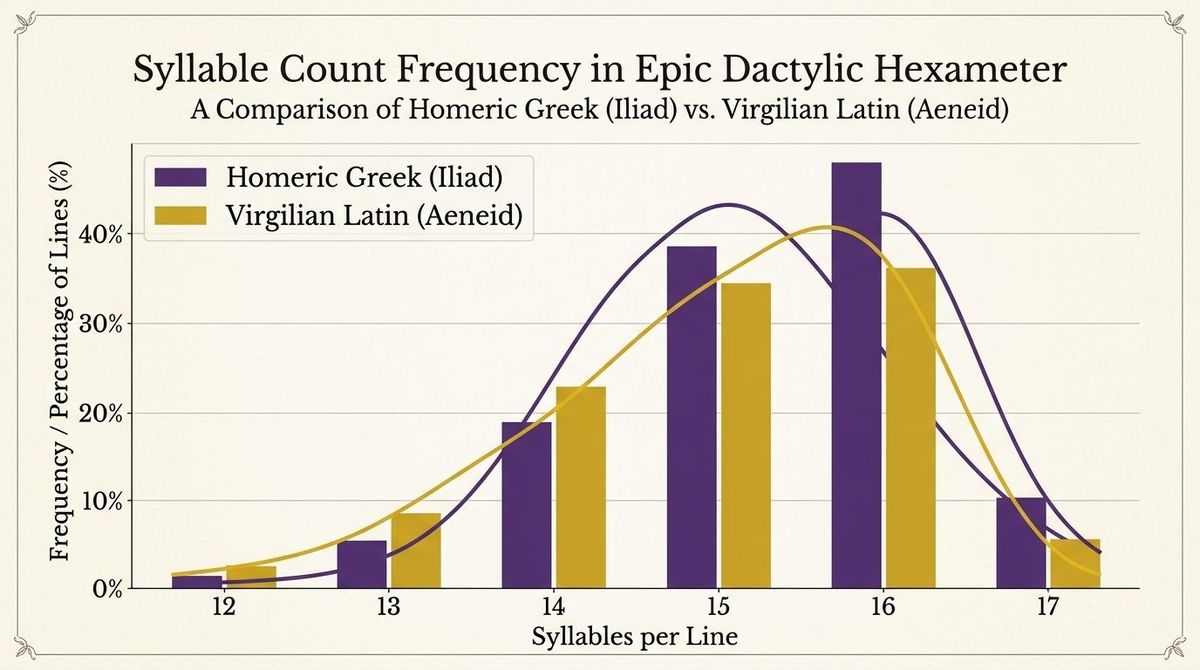
Virgil favors the balanced 15-syllable line (2 spondees and 3 dactyls), whereas Homeric Greek poetry leans toward lighter 16- and 17-syllable verses due to Ancient Greek's abundant short inflectional endings.
Rhetorical Significance of the Caesura and Diaeresis
A hexameter line never runs continuously without internal structural breaks. The caesura represents a mandatory pause between words occurring inside a metrical foot:
- Trithemimeral Caesura: Word break after the first syllable of the second foot (Foot 1.5).
- Penthemimeral Caesura: Word break after the first syllable of the third foot (Foot 2.5), representing the primary rhetorical dividing point in over 85% of Latin epic verses.
- Hephthemimeral Caesura: Word break after the first syllable of the fourth foot (Foot 3.5), frequently paired with a secondary trithemimeral break.
- Bucolic Diaeresis: When a clean word boundary coincides exactly with the end of the fourth foot (before the fifth foot begins), producing the classic pastoral cadence favored by Theocritus.
Frequently Asked Questions
Why is the final syllable of a hexameter line called an anceps?
The Latin term anceps means "two-headed" or variable. In the sixth foot (\(-\ \underline{\cup}\)), the final syllable can be either naturally short or long. Because the recitation concludes with a natural pause at line end, even a short vowel is treated metrically as long by duration.
What is a versus spondaicus?
A versus spondaicus occurs when a poet places a spondee in the fifth foot instead of the standard dactyl. This substitution slows the line dramatically before the cadence, signaling epic solemnity, horror, or monumental weight.
How do elisions affect syllable counting in scansion exams?
Elisions suppress one syllable completely from the metrical count. If a line orthographically displays 16 syllables but contains one elision, the scanned metrical syllable count is 15. Failing to account for elisions is the most common error in metrical scansion tests.
Can English poetry sustain true quantitative dactylic hexameter?
Because English is a stress-timed language rather than a mora-timed language, English hexameters (such as Longfellow's Evangeline) rely on accented beats (stress) rather than vowel length, making authentic quantitative dactyls difficult to sustain over long narrative stanzas.
Analyze Your Poetry Syllables and Metrical Feet
Whether scanning classical Latin epics or analyzing modern poetic meter, accurate syllable division is essential. Test line syllable counts, phonetic breaks, and rhythm structures with our specialized scansion utilities at Count Syllable.