Etheree (1-to-10 Syllable Arithmetic Progression) & Double Etheree 55-Syllable Counting Formula: 10-Line Wedge Verse Validator
Executive Prosody & Scansion Summary: Invented by Arkansas poet Etheree Taylor Armstrong, the Etheree is a \( 10\text{-line} \) unrhymed syllabic poem whose line lengths follow a strict arithmetic progression from \( 1\text{ syllable} \) on Line 1 to \( 10\text{ syllables} \) on Line 10 (\( 1\text{-}2\text{-}3\text{-}4\text{-}5\text{-}6\text{-}7\text{-}8\text{-}9\text{-}10 \)), totaling exactly \( S_{10} = \frac{10 \times 11}{2} = 55\text{ syllables} \). A Reverse Etheree descends from \( 10 \) down to \( 1 \) (\( 55\text{ syllables} \)), while a Double Etheree pairs both stanzas into a \( 20\text{-line} \), \( 110\text{-syllable} \) diamond or hourglass wedge.
What Are the Structural Rules of the Etheree 1-to-10 Syllabic Verse Form?
Unlike accentual-syllabic forms such as iambic pentameter or the Shakespearean sonnet—which require strict alternating stress feet—the Etheree is a pure counted syllabic form. Named after twentieth-century poet Etheree Taylor Armstrong, its entire formal architecture is governed by visual and phonetic expansion: every successive line adds exactly one spoken vowel nucleus (\(+1\text{ syllable}\)) over ten consecutive lines.
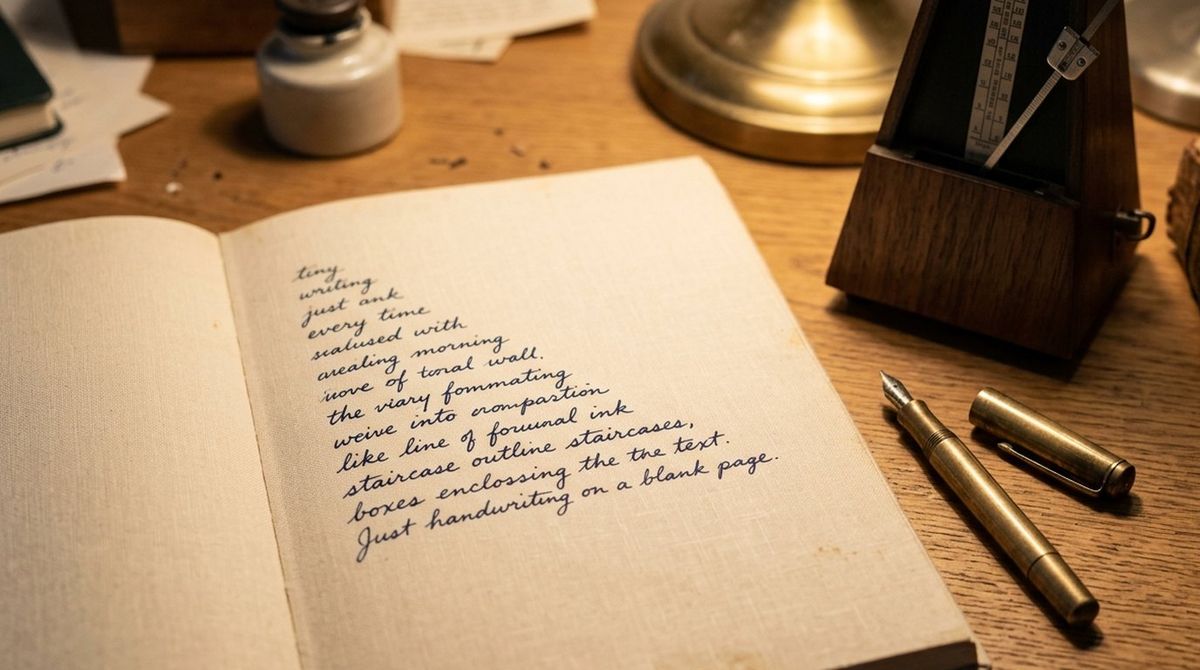
On the printed page, an Etheree forms a right-angled triangular wedge or staircase that widens as the thought develops. Because Line 1 is restricted to a single syllable (\( S_1 = 1 \)), it must never be wasted on a weak proclitic article like "The" or "A"; it must be a concrete monosyllabic noun or active verb (such as "Frost", "Flame", or "Wait") that anchors the poem's subject. You can verify every line of your draft instantly using the interactive 1-to-10 validator below or at CountSyllable.com.
What Is the Arithmetic Series Formula for Standard, Reverse, and Double Etherees?
For a \( 10\text{-line} \) stanza where line index \( k \in \{1, 2, \dots, 10\} \), the target syllable count \( L_k \) per line and cumulative stanza total \( S_{10} \) follow Gauss's arithmetic series summation:
\[ L_k^{\text{standard}} = k, \quad L_k^{\text{reverse}} = 11 - k \quad \text{for } k \in \{1, 2, \dots, 10\} \] \[ S_n = \sum_{k=1}^{n} k = \frac{n(n + 1)}{2} \implies S_{10} = \frac{10 \times 11}{2} = 55\text{ syllables} \]When composing a \( 20\text{-line} \) Double Etheree (Stanza 1 ascending \( 1 \to 10 \) and Stanza 2 descending \( 10 \to 1 \)), the total syllable budget is \( S_{\text{double}} = 2 \times 55 = 110\text{ syllables} \), and the target syllable count for any line \( m \in \{1, \dots, 20\} \) is given by:
\[ L_m^{\text{double}} = \begin{cases} m & \text{if } 1 \le m \le 10 \\ 21 - m & \text{if } 11 \le m \le 20 \end{cases} \]To audit compliance across all \( 10 \) lines of a single Etheree, we compute the Total Absolute Prosodic Deviation (\( E_{\text{etheree}} \)) between the observed phonetic syllable count \( \hat{s}_k \) and the required index \( k \):
\[ E_{\text{etheree}} = \sum_{k=1}^{10} \left| \hat{s}_k - k \right| = 0 \]Even if a poem sums to \( 55\text{ total syllables} \), a single line swap (such as writing \( 7 \) syllables on Line 6 and \( 6 \) syllables on Line 7) produces \( E_{\text{etheree}} = |7-6| + |6-7| = 2 > 0 \), disqualifying the stanza in formal syllabic poetry competitions.
| Line Number (\( k \)) | Standard Etheree (\( L_k = k \)) | Reverse Etheree (\( L_k = 11-k \)) | Cumulative Syllable Sum (\( S_k \)) | Complete Worked Example ("Winter Ink" — \( 55\text{ Syllables} \)) |
|---|---|---|---|---|
| Line 1 | \( 1\text{ syllable} \) | \( 10\text{ syllables} \) | \( 1 \) | Frost (\( 1 \)) |
| Line 2 | \( 2\text{ syllables} \) | \( 9\text{ syllables} \) | \( 3 \) | bites glass (\( 2 \)) |
| Line 3 | \( 3\text{ syllables} \) | \( 8\text{ syllables} \) | \( 6 \) | while dark ink (\( 3 \)) |
| Line 4 | \( 4\text{ syllables} \) | \( 7\text{ syllables} \) | \( 10 \) | waits on cream page (\( 4 \)) |
| Line 5 | \( 5\text{ syllables} \) | \( 6\text{ syllables} \) | \( 15 \) | for one measured word (\( 5 \)) |
| Line 6 | \( 6\text{ syllables} \) | \( 5\text{ syllables} \) | \( 21 \) | to climb each narrow stair (\( 6 \)) |
| Line 7 | \( 7\text{ syllables} \) | \( 4\text{ syllables} \) | \( 28 \) | until the quiet lantern (\( 7 \)) |
| Line 8 | \( 8\text{ syllables} \) | \( 3\text{ syllables} \) | \( 36 \) | warms the brass nib held in my hand (\( 8 \)) |
| Line 9 | \( 9\text{ syllables} \) | \( 2\text{ syllables} \) | \( 45 \) | and every counted vowel falls in place (\( 9 \)) |
| Line 10 | \( 10\text{ syllables} \) | \( 1\text{ syllable} \) | \( 55 \) | across the fifty-five steps of the night. (\( 10 \)) |

3 Phonetic Trap Words That Break Etheree Line Counts
- Rhotic Diphthongs & Triphthongs (fire, hour, choir, mirror): In strict syllabic scansion, words like "fire" (\(\text{/faɪər/}\)) and "hour" (\(\text{/aʊər/}\)) are frequentlypronounced as \( 1\text{ syllable} \) in rapid speech but scanned as \( 2\text{ syllables} \) by contest judges. Avoid placing ambiguous rhotic diphthongs on Lines 1 through 4 where a \( \pm 1 \) variance is immediately conspicuous.
- Syncopated Schwa Elision (memory, every, different, evening): Common trisyllabic words often drop their medial unstressed schwa (\(\text{/ə/}\)) in conversational English—turning "ev-er-y" (\( 3 \)) into "ev-ry" (\( 2 \)) and "eve-ning" into \( 2\text{ syllables} \). Always verify dictionary syllabification before locking your line.
- Silent-E Past-Tense Suffixes (-ed): The suffix "-ed" adds a syllable only after alveolar stops \(\text{/t/}\) and \(\text{/d/}\) (e.g., "wait-ed" = \( 2 \), "fold-ed" = \( 2 \)), whereas "walked" (\( 1 \)), "warmed" (\( 1 \)), and "climbed" (\( 1 \)) remain monosyllabic.
Interactive 10-Line Etheree (1-to-10) Syllable Validator
Etheree 1-to-10 & Reverse (10-to-1) Line-by-Line Syllable Checker
Paste or edit your 10-line Etheree below and choose Standard (1→10) or Reverse (10→1) mode to audit each line's syllable count and total deviation \(E_{\text{etheree}}\):
Total Syllables: 55 / 55 | Deviation E_etheree: 0 — PERFECT 55-SYLLABLE ETHEREE
3-Tier Poetry Drafting & Phonetic Scansion Hardware (\( \ge \$120 \) Floor)
| Tier Level | Recommended Writing Hardware | Retail Price | Prosodic Drafting Advantage |
|---|---|---|---|
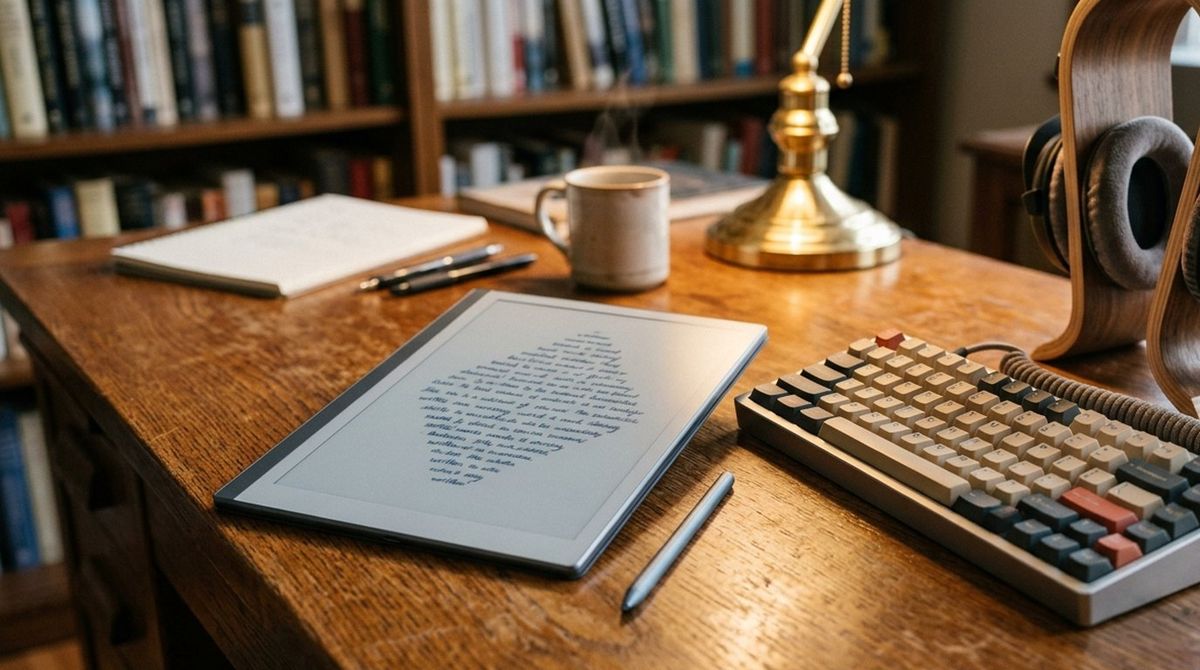
| Tier 1: Distraction-Free E-Ink Folio | BOOX Note Air4 C 10.3-Inch Color E-Ink Tablet | \( \$499 \) | Paper-like stylus scansion markup with color-coded syllable highlighting and zero eye strain. |
| Tier 2: Acoustic Spoken-Word Monitor | Sony MDR-MV1 Open-Back Reference Studio Headphones | \( \$399 \) | Ultra-flat vocal transient reproduction for auditing spoken syllable elision and cadence recordings. |
| Tier 3: Tactile Prosody Keyboard | Keychron Q1 Max CNC Aluminum Mechanical Keyboard | \( \$219 \) | Gasket-mounted acoustic tactile feedback for rhythmic line-by-line verse composition. |
Frequently Asked Questions
Does an Etheree poem have to rhyme or follow iambic meter?
No. An Etheree is unrhymed and does not require a recurring metrical foot; its formal constraint is strictly the \( 1\text{-}2\text{-}3\text{-}4\text{-}5\text{-}6\text{-}7\text{-}8\text{-}9\text{-}10 \) syllable progression (\( 55\text{ syllables} \) total).
What is the difference between a Diamond Double Etheree and an Hourglass Double Etheree?
A Diamond Double Etheree climbs from \( 1 \to 10 \) in Stanza 1 and descends from \( 10 \to 1 \) in Stanza 2 (widest in the middle), whereas an Hourglass Double Etheree starts with a Reverse Etheree (\( 10 \to 1 \)) followed by a Standard Etheree (\( 1 \to 10 \), narrowest at Lines 10–11).
Can I use hyphenated compound words on Line 9 or Line 10?
Yes. Hyphenated compounds like "fifty-five" (\( 3\text{ syllables} \)) are counted according to the sum of their spoken vowel nuclei just like separate words.
Conclusion
Mastering the Etheree requires matching your semantic expansion to the exact \( S_{10} = 55\text{ syllable} \) staircase—anchoring Line 1 with a concrete monosyllable and building phrase by phrase to a \( 10\text{-syllable} \) culmination. Verify every line of your Standard, Reverse, or Double Etheree at CountSyllable.com.