Flesch-Kincaid Syllable Readability & Grade Level Formula: Why Syllable Weight Dominates Conversion Copy
Every automated readability scorer in modern publishing and conversion copywriting relies on two linear equations developed by Rudolf Flesch and J. Peter Kincaid: the Flesch Reading Ease \( \left( \text{FRE} \right) \) score and the Flesch-Kincaid Grade Level \( \left( \text{FKGL} \right) \) formula. While writers instinctively split long sentences to lower their reading grade level, examining the partial derivatives of the Flesch-Kincaid equation reveals a striking mathematical asymmetry: average syllables per word \( \left( \text{ASW} \right) \) is weighted \( 11.8\times \) versus just \( 0.39\times \) for average sentence length \( \left( \text{ASL} \right) \). Because syllable density carries nearly \( 30\times \) (\( 30.26\times \)) the algebraic weight of sentence length, replacing polysyllabic Latinate nominalizations with crisp monosyllabic and disyllabic words drops reading grade level by \( -4.1\text{ grades} \) in a single editing pass.

The Exact Flesch-Kincaid Grade Level and Reading Ease Equations
Both readability metrics are linear functions of two corpus ratios derived from total words \( \left( N_{\text{words}} \right) \), total sentences \( \left( N_{\text{sentences}} \right) \), and total phonetic syllables \( \left( N_{\text{syllables}} \right) \):
\[ \text{ASL} = \frac{N_{\text{words}}}{N_{\text{sentences}}}, \qquad \text{ASW} = \frac{N_{\text{syllables}}}{N_{\text{words}}} \]The Flesch-Kincaid Grade Level \( \left( \text{FKGL} \right) \) maps those two ratios onto U.S. school grade equivalents:
\[ \text{FKGL} = 0.39 \times \left( \frac{N_{\text{words}}}{N_{\text{sentences}}} \right) + 11.8 \times \left( \frac{N_{\text{syllables}}}{N_{\text{words}}} \right) - 15.59 \]In compact ratio notation, this is written as:
\[ \text{FKGL} = \left( 0.39 \times \text{ASL} \right) + \left( 11.8 \times \text{ASW} \right) - 15.59 \]Complementing Grade Level, the Flesch Reading Ease \( \left( \text{FRE} \right) \) formula scales readability from \( 0 \) (dense academic prose) to \( 100 \) (effortless consumer copy), where higher scores indicate lower cognitive friction:
\[ \text{FRE} = 206.835 - \left( 1.015 \times \text{ASL} \right) - \left( 84.6 \times \text{ASW} \right) \]Notice the syllable penalty term \( 84.6 \times \text{ASW} \) inside the Reading Ease equation and \( 11.8 \times \text{ASW} \) inside the Grade Level equation. In both formulas, the coefficient attached to syllable density dwarfs the coefficient attached to sentence length.
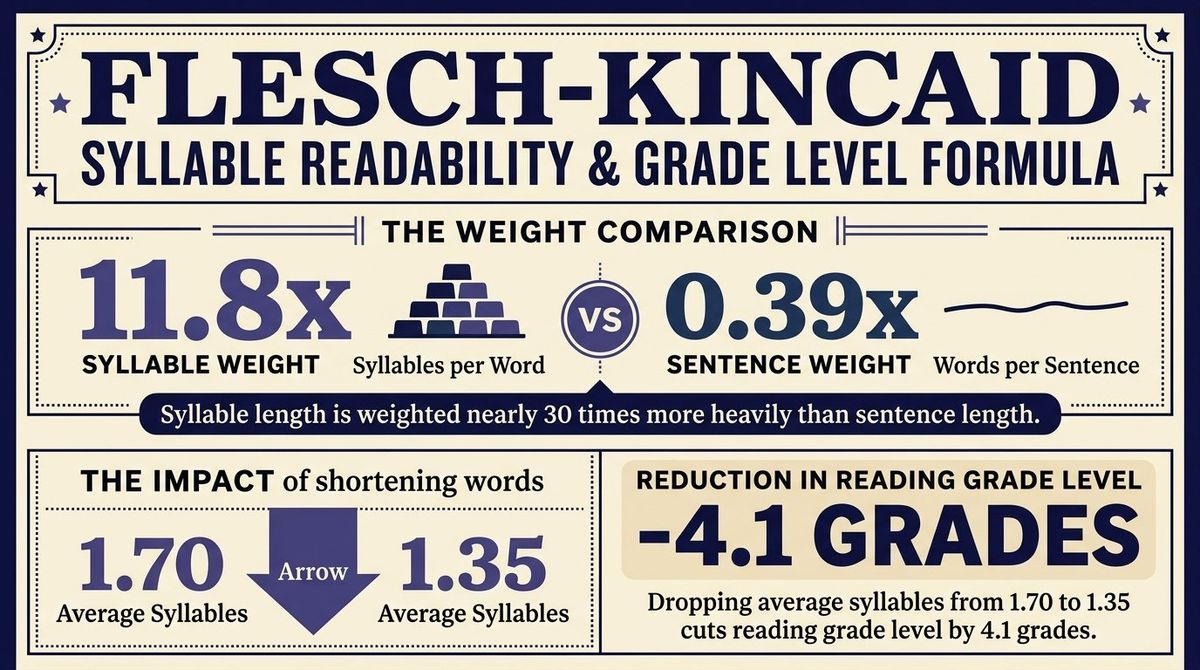
Sensitivity Proof: Why Syllable Weight Beats Sentence Splitting by 30.26x
Taking the partial derivatives of \( \text{FKGL} \) with respect to \( \text{ASW} \) and \( \text{ASL} \) quantifies the exact sensitivity of each variable:
\[ \frac{\partial (\text{FKGL})}{\partial (\text{ASW})} = 11.8, \qquad \frac{\partial (\text{FKGL})}{\partial (\text{ASL})} = 0.39 \]Dividing the syllable weight by the sentence weight gives the exact leverage ratio:
\[ \text{Leverage Ratio} = \frac{11.8}{0.39} = 30.256 \approx 30\times \]In practical terms, reducing your average syllables per word from \( 1.70\text{ syllables/word} \) (typical B2B corporate prose) down to \( 1.35\text{ syllables/word} \) (crisp conversational copy)—a delta of \( \Delta \text{ASW} = -0.35\text{ syllables/word} \)—produces an immediate grade level drop of:
\[ \Delta \text{FKGL} = 11.8 \times \left( 1.35 - 1.70 \right) = 11.8 \times \left( -0.35 \right) = -4.13 \approx -4.1\text{ grades} \]To achieve that exact same \( -4.13\text{ grade} \) reduction solely by shortening sentences without simplifying your vocabulary, you would have to slash your average sentence length by \( \frac{4.13}{0.39} = 10.59\text{ words per sentence} \) (for example, chopping every \( 18\text{ word} \) sentence into choppy \( 7.4\text{ word} \) fragments). In the Flesch Reading Ease equation, that same \( -0.35 \) syllable reduction boosts your score by \( 84.6 \times 0.35 = +29.61\text{ points} \).
Worked SaaS Landing Page Audit: Grade 13.4 Academic Drag vs. Grade 6.5 High-Converting Copy
Consider a real-world SaaS landing page draft suffering from what enterprise marketers call Grade 13+ Academic B2B Drag (\( 1.85+\text{ syllables/word} \)) versus a syllable-audited Grade 6–7 High-Converting Copy challenger (\( 1.35\text{ syllables/word} \)).
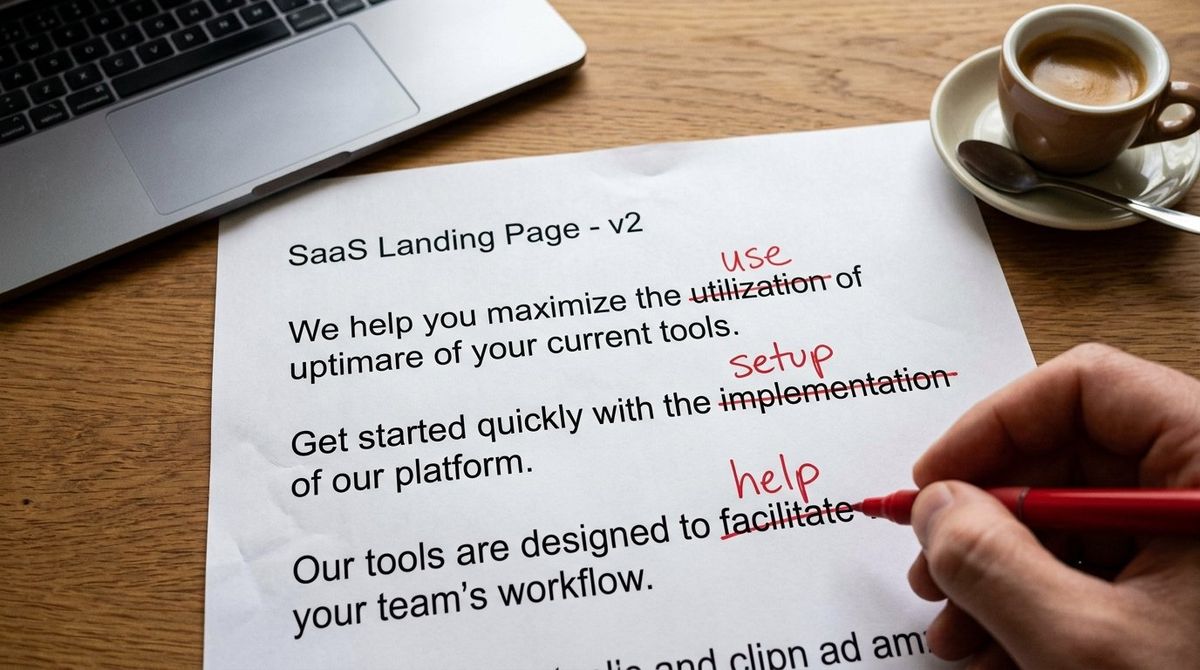
Step 1: Auditing the Polysyllabic B2B Draft
Suppose a 100-word SaaS hero and sub-hero block contains \( 5\text{ sentences} \) \( \left( \text{ASL} = 20.0\text{ words/sentence} \right) \) and \( 170\text{ total syllables} \) \( \left( \text{ASW} = 1.70\text{ syllables/word} \right) \)—or \( 185\text{ syllables} \) \( \left( \text{ASW} = 1.85\text{ syllables/word} \right) \) in heavy enterprise copy:
- At \( \text{ASW} = 1.70 \) and \( \text{ASL} = 20.0 \): \[ \text{FKGL} = \left( 0.39 \times 20.0 \right) + \left( 11.8 \times 1.70 \right) - 15.59 = 7.80 + 20.06 - 15.59 = 12.27\text{ (Grade 12.3)} \] \[ \text{FRE} = 206.835 - \left( 1.015 \times 20.0 \right) - \left( 84.6 \times 1.70 \right) = 206.835 - 20.30 - 143.82 = 42.72 \]
- At \( \text{ASW} = 1.85 \) and \( \text{ASL} = 20.0 \) (Grade 13+ Academic B2B Drag): \[ \text{FKGL} = \left( 0.39 \times 20.0 \right) + \left( 11.8 \times 1.85 \right) - 15.59 = 7.80 + 21.83 - 15.59 = 14.04\text{ (Grade 14.0)} \] \[ \text{FRE} = 206.835 - 20.30 - \left( 84.6 \times 1.85 \right) = 206.835 - 20.30 - 156.51 = 30.03 \]
Step 2: Performing the 3-Word Syllable Substitution
Now keep the sentence cadence natural \( \left( \text{ASL} = 16.0\text{ to }20.0\text{ words/sentence} \right) \), but execute three systematic lexical swaps shown in Figure 3 across the draft:
- Replace "utilization" \( \left( 5\text{ syllables} \right) \) with "use" \( \left( 1\text{ syllable} \right) \) — saving \( 4\text{ syllables} \) per occurrence.
- Replace "implementation" \( \left( 5\text{ syllables} \right) \) with "setup" \( \left( 2\text{ syllables} \right) \) — saving \( 3\text{ syllables} \) per occurrence.
- Replace "facilitate" \( \left( 4\text{ syllables} \right) \) with "help" \( \left( 1\text{ syllable} \right) \) — saving \( 3\text{ syllables} \) per occurrence.
Dropping \( \text{ASW} \) from \( 1.70 \) to \( 1.35\text{ syllables/word} \) pulls the exact same \( 20.0\text{ word/sentence} \) passage down by \( -4.13\text{ grades} \) to \( \text{FKGL} = 8.14 \), and pairing \( \text{ASW} = 1.35 \) with a conversational \( \text{ASL} = 16.0\text{ words/sentence} \) lands squarely in the Grade 6–7 High-Converting Copy zone:
\[ \text{FKGL}_{\text{optimized}} = \left( 0.39 \times 16.0 \right) + \left( 11.8 \times 1.35 \right) - 15.59 = 6.24 + 15.93 - 15.59 = 6.58\text{ (Grade 6.6)} \] \[ \text{FRE}_{\text{optimized}} = 206.835 - \left( 1.015 \times 16.0 \right) - \left( 84.6 \times 1.35 \right) = 206.835 - 16.24 - 114.21 = 76.39 \]Complete Readability & Conversion Benchmark Matrix
Use the reference matrix below to benchmark your copy's \( \text{ASW} \), \( \text{ASL} \), Flesch Reading Ease, and Flesch-Kincaid Grade Level before launching paid traffic or publishing organic guides:
| Copy Tier & Use Case | Average Syllables / Word \( \left( \text{ASW} \right) \) | Average Sentence Length \( \left( \text{ASL} \right) \) | Flesch-Kincaid Grade Level \( \left( \text{FKGL} \right) \) | Flesch Reading Ease \( \left( \text{FRE} \right) \) |
|---|---|---|---|---|
| Direct-Response Ad & Hero Copy | \( 1.25\text{--}1.32\text{ syllables/word} \) | \( 11.0\text{--}14.0\text{ words} \) | Grade 4.0–5.5 | \( 80.0\text{--}89.0 \) |
| High-Converting SaaS & Landing Copy | \( 1.35\text{ syllables/word} \) | \( 14.0\text{--}17.0\text{ words} \) | Grade 6–7 (6.2–7.0) | \( 73.0\text{--}78.5 \) |
| Technical Authority & How-To Guides | \( 1.50\text{--}1.60\text{ syllables/word} \) | \( 17.0\text{--}20.0\text{ words} \) | Grade 8.8–10.5 | \( 52.0\text{--}64.0 \) |
| Unedited Corporate Draft (Baseline) | \( 1.70\text{ syllables/word} \) | \( 20.0\text{ words} \) | Grade 12.3 | \( 42.7 \) |
| Academic B2B Drag (High Cognitive Load) | \( 1.85+\text{ syllables/word} \) | \( 20.0\text{--}25.0\text{ words} \) | Grade 13+ (14.0–16.0) | \( 25.0\text{--}30.0 \) |
Phonetic vs. Orthographic Syllable Counting Edge Cases
When auditing copy programmatically, naive vowel-cluster regular expressions miscount English words with silent trailing vowels or syllabic consonants, skewing \( \text{ASW} \) by \( \pm 0.08\text{ syllables/word} \) (which shifts \( \text{FKGL} \) by nearly a full grade level: \( 11.8 \times 0.08 = 0.94\text{ grades} \)). Keep three phonetic rules in mind when verifying syllable counts:
- Silent Trailing -e and -ed Endings: Words like "rate" \( \left( 1\text{ syllable} \right) \), "streamlined" \( \left( 2\text{ syllables} \right) \), and "shipped" \( \left( 1\text{ syllable} \right) \) drop the orthographic final vowel in spoken English unless preceded by an alveolar stop \( \left( \text{/t/ or /d/} \right) \) as in "funded" \( \left( 2\text{ syllables} \right) \).
- Consonant + -le Endings: Words ending in a consonant followed by -le such as "table" \( \left( 2\text{ syllables} \right) \) or "syllable" \( \left( 3\text{ syllables} \right) \) form a syllabic lateral \( \left( \text{/əl/} \right) \) despite the silent final letter.
- High-Penalty Latinate Suffixes: Suffix chains like -ization \( \left( +4\text{ syllables} \right) \), -ibility \( \left( +4\text{ syllables} \right) \), and -ational \( \left( +3\text{ syllables} \right) \) inflate \( \text{ASW} \) faster than any other grammatical structure. Eliminating just five 5-syllable nominalizations in a 150-word email cuts \( N_{\text{syllables}} \) by \( 18\text{ to }20\text{ syllables} \), reducing \( \text{ASW} \) by \( -0.12\text{ to }-0.13\text{ syllables/word} \) and dropping \( \text{FKGL} \) by \( -1.4\text{ to }-1.5\text{ grades} \) instantly.