How to Count Syllables in English: The 4 Core Phonetic Rules, Exceptions, and Meter Verification
Understanding how to count syllables in English is a foundational skill for poets crafting strict meter, educators assessing student readability, and digital writers optimizing text for web consumption. Because English spelling is notoriously irregular, relying solely on written vowel letters leads to frequent miscounts.
Key Takeaways: - Sound Over Spelling: Syllables are defined by spoken vowel sounds (nuclei), not written vowel letters. - The Master Rule: Total Syllables = Written Vowels - Silent Vowels - Diphthongs + Syllabic Consonants. - Colloquial Elision: Everyday speech naturally compresses three-syllable written words like "chocolate" or "camera" into two spoken syllables.
The Core Definition and Master Syllable Rule
A syllable is an uninterrupted unit of spoken language consisting of a single vowel sound (the phonetic nucleus), with or without surrounding consonant sounds.
To calculate syllables accurately across complex vocabulary, apply this master rule:
Master Syllable Calculation Rule: $$\text{Syllables} =\text{Total Vowel Letters} -\text{Silent Vowels} -\text{Combined Diphthongs} +\text{Syllabic Consonants}$$
Because a single spoken vowel sound forms the core of every syllable, counting heard vowel pulses—rather than counting letters on the page—is the key to accuracy.
You can reference linguistic standards and phonetic guidelines through educational resources like the Linguistic Society of America.
The 4 Fundamental Syllable Counting Rules
Mastering these four core rules allows you to decode virtually any English word quickly and accurately:
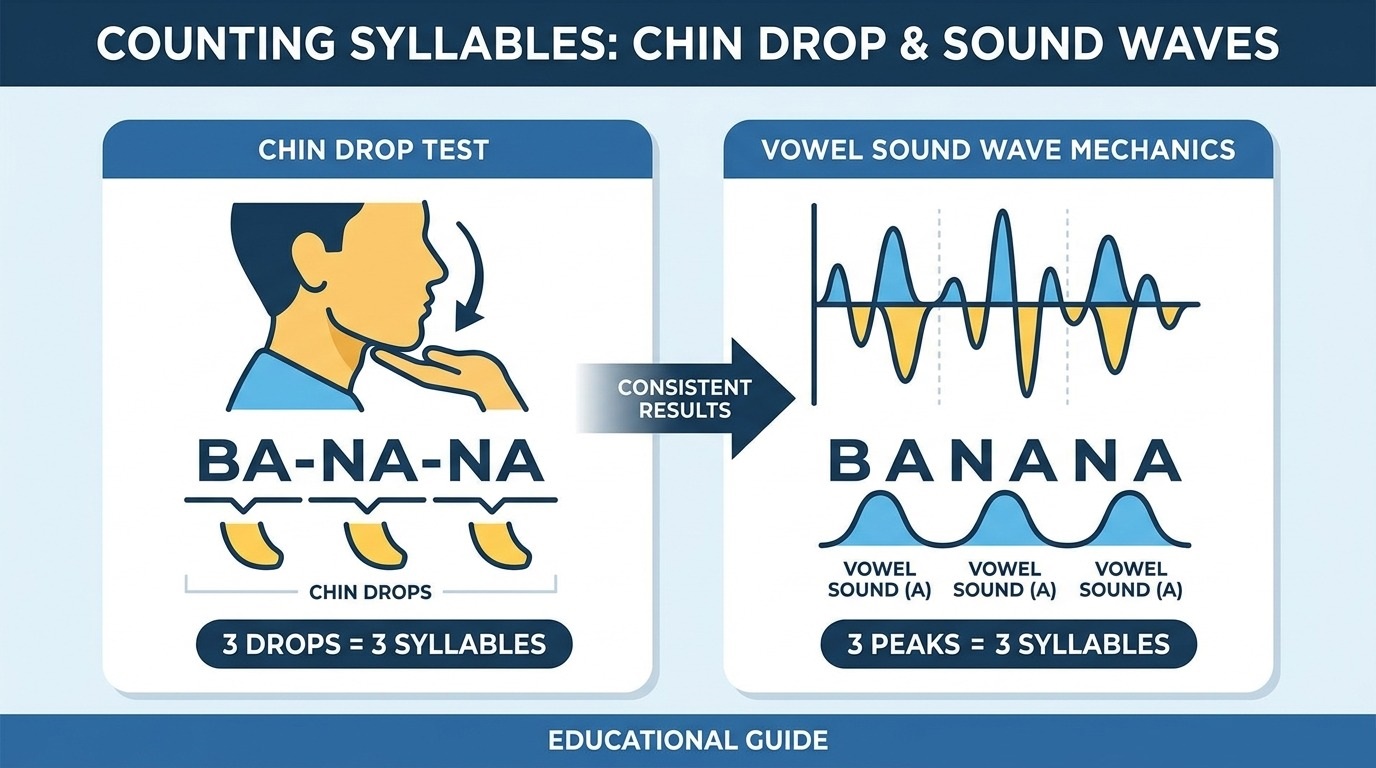
1. The Chin Drop Test
Place your hand flat beneath your jawline and pronounce the word at a normal speaking pace. Every time your chin physically lowers to create a distinct open vowel sound, count one syllable (e.g., "ap-ple" drops twice; "el-e-phant" drops three times).
2. The Silent "E" Rule
An ending "e" in English is typically silent and serves to lengthen the preceding vowel sound rather than forming a new syllable (e.g., "cake" has two vowel letters but only one spoken syllable; "wanted" has two syllables because the "-ed" suffix is explicitly voiced).
3. The Diphthong / Vowel Team Rule
When two or three written vowel letters merge to produce a single combined sound (a diphthong or digraph), they form only one syllable (e.g., "meat" = 1; "cloud" = 1; "coin" = 1).
4. The Syllabic Consonant Exception
In certain English words, sonorant consonants like /m/ or /l/ function as a complete syllable without any written vowel letter present (e.g., "rhythm" = 2 syllables: rhyth-m; "prism" = 2 syllables; "bottle" = 2 syllables: bot-tle).
Tricky Words Breakdown & Phonetic Reference
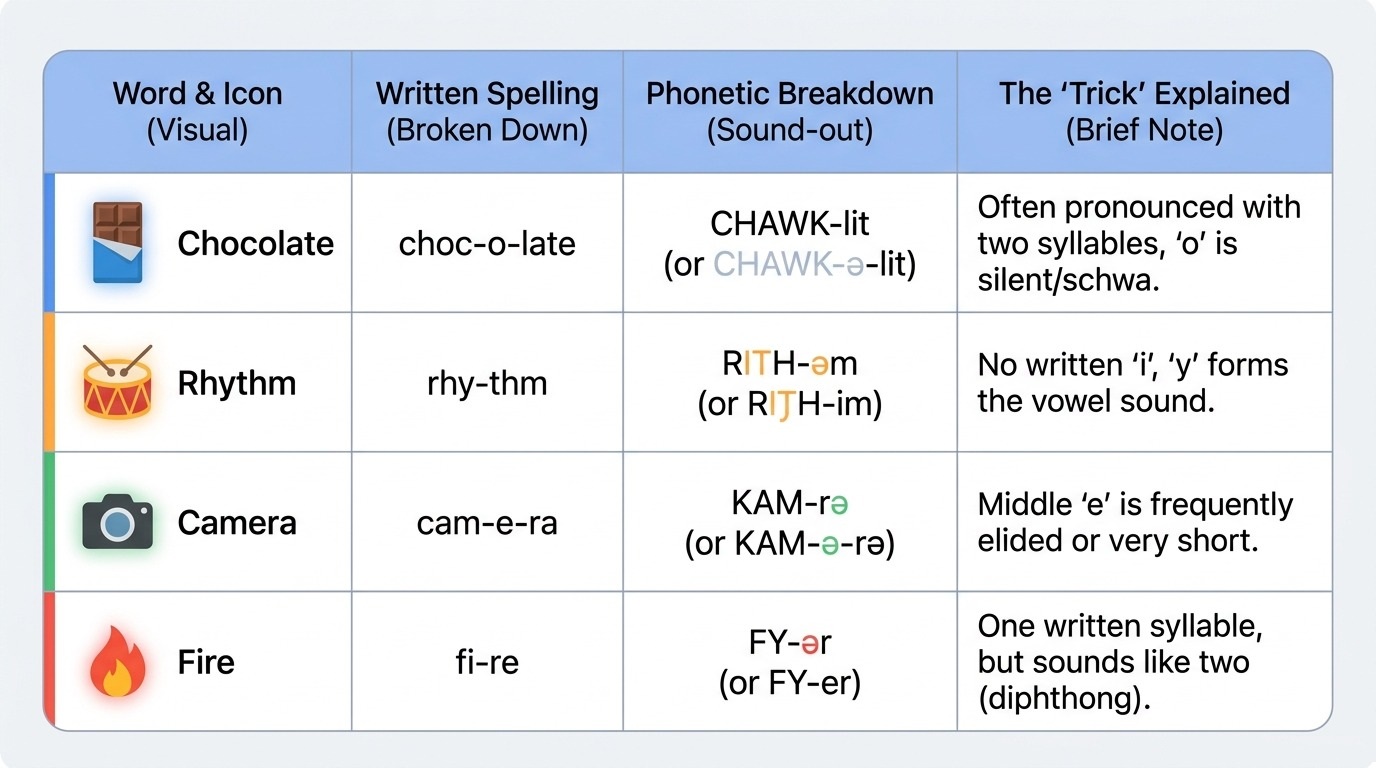
English colloquial speech frequently drops unstressed middle vowels—a process known as syncope. Use this reference table to avoid common counting mistakes:
| Target Word | Written Vowels | Spoken Syllables | Phonetic Division | Common Miscount Trap |
|---|---|---|---|---|
| Chocolate | 4 (o, o, a, e) | 2 Syllables | choc-late | Pronouncing as 3 syllables (choc-o-late) |
| Camera | 3 (a, e, a) | 2 Syllables | cam-ra | Pronouncing as 3 syllables (cam-er-a) |
| Every | 3 (e, e, y) | 2 Syllables | ev-ry | Pronouncing as 3 syllables (ev-er-y) |
| Fire / Wire | 2 (i, e) | 1 Syllable | fire (phonetic) | Treated as 2 syllables in traditional poetry |
| Business | 3 (u, i, e) | 2 Syllables | biz-ness | Pronouncing as 3 syllables (bus-i-ness) |
Poetic Meter and Readability Impact
Accurate syllable counting plays a vital role in two major writing disciplines:
1. Verifying Haiku Structure
Traditional Japanese Haiku translations require a strict 5-7-5 syllable arrangement across three lines (5 syllables in Line 1, 7 in Line 2, and 5 in Line 3). Miscounting words like "rhythm" or "every" ruins the rhythm of the poem.
2. Flesch-Kincaid Grade Level Readability
Readability algorithms, including Flesch-Kincaid, use average sentence length and average syllables per word to calculate grade scores. Using multi-syllable corporate jargon inflates readability scores, making online content harder to scan.
Actionable Syllable Counting Checklist
Follow this checklist when checking text for poetic meter or readability scoring:
- Say the word aloud at a natural conversational speed.
- Perform the chin drop test to count distinct physical jaw drops.
- Subtract silent ending "e" letters and combined vowel teams.
- Add syllabic consonants ending in "-m" or "-le" (e.g., rhythm, table).
- Check regional poetic conventions for words like fire or real.
Free Syllable Counter Tool
Polishing a haiku, lyrics, or grading student readability? Paste your text or poem into our free Syllable Counter above to instantly verify word-by-word counts and poetic meter.
Frequently Asked Questions (FAQ)
Is 'rhythm' one or two syllables?
'Rhythm' is two syllables (rhyth-m). Although the second syllable contains no written vowel letter, the sonorant consonant '/m/' forms a syllabic nucleus, creating a distinct second spoken unit.
Why does 'fire' count as both one and two syllables in poetry?
Phonetically in standard American English, 'fire' is pronounced as a single triphthong syllable (/faɪər/). However, in classical poetry and song lyrics, poets frequently treat 'fire' as two syllables (fi-re) to satisfy metric requirements like iambic pentameter.
How does syllable count affect SEO readability scores?
Search engine algorithms favor clear, accessible content that readers can digest quickly. Shorter words with fewer syllables reduce paragraph complexity, lowering your Flesch-Kincaid Grade Level score and improving user retention on web pages.