5 Foolproof Methods on How to Count Syllables in a Poem and Master Meter
A single dropped beat can shatter the emotional resonance of an entire stanza. Whether you are drafting a classic Shakespearean sonnet or editing a contemporary lyric essay, understanding how to count syllables in a poem is the foundational bedrock of rhythm. Unfortunately, the English language is notoriously chaotic, filled with silent vowels, regional dialects, and complex morphological structures that make manual counting incredibly frustrating.
Many amateur poets rely entirely on their ear, leading to inconsistent metrical feet that stumble on the page. True metrical mastery requires moving beyond intuition. By applying strict linguistic rules and structural scansion techniques, you can diagnose rhythmic errors with surgical precision and elevate your poetry from amateur verse to professional literature.
Quick Answer / Key Takeaways * Syllables are defined by vowel phonemes (sounds), not by the literal number of printed vowel letters. * Breaking words down into their morphological components (prefixes, roots, suffixes) drastically reduces miscounts in multisyllabic words. * Scansion—the act of visually marking stressed and unstressed beats—is mandatory for verifying iambic, trochaic, and dactylic meter.
1. The Vowel Phoneme Rule (Sonority)
The most catastrophic mistake editors make when learning how to count syllables in a poem is counting the letters instead of the sounds. A syllable is fundamentally a unit of pronunciation containing a single vowel phoneme (a distinct vowel sound), which may or may not be surrounded by consonants.
Consider the word "beautiful." It contains five printed vowel letters (e, a, u, i, u), but only three distinct vowel sounds (/bju/, /tɪ/, /fəl/). Furthermore, you must aggressively hunt for silent "E"s at the ends of words, as they dictate the pronunciation of the preceding vowel but do not create a syllable themselves (e.g., "breathe" is one syllable, not two).
2. Morphological Prefix and Suffix Division
When dealing with complex, multisyllabic vocabulary in a poem, auditory guessing often fails. Instead, you must dismantle the word using morphological division. This involves physically separating the word's root from its prefixes and suffixes, as these affixes usually function as independent syllables.
For example, the word "unbelievable" can be mathematically broken down: the prefix "un-" (1), the root "be-lieve" (2), and the suffix "-a-ble" (2), totaling five syllables. According to the Poetry Foundation's glossary of poetic terms, dissecting words morphologically is the safest way to ensure your metrical feet do not become bloated with hidden syllables.
3. The Physical "Chin Drop" Technique
If you are a lyricist or spoken-word poet, you must account for the physical mechanics of speech. The "chin drop" technique is a foolproof, biological method for counting syllables. Place the back of your hand flat beneath your chin and recite the line of poetry with exaggerated articulation.
Every time your jaw drops to vocalize a vowel sound, your chin will physically strike your hand. Each strike equals one syllable. This method is particularly excellent for catching elisions—where two syllables blur into one in natural speech, such as pronouncing "wandering" as two syllables ("wand-ring") instead of three ("wan-der-ing") to fit the poem's meter.
4. Metrical Foot Scansion (Iambs and Trochees)
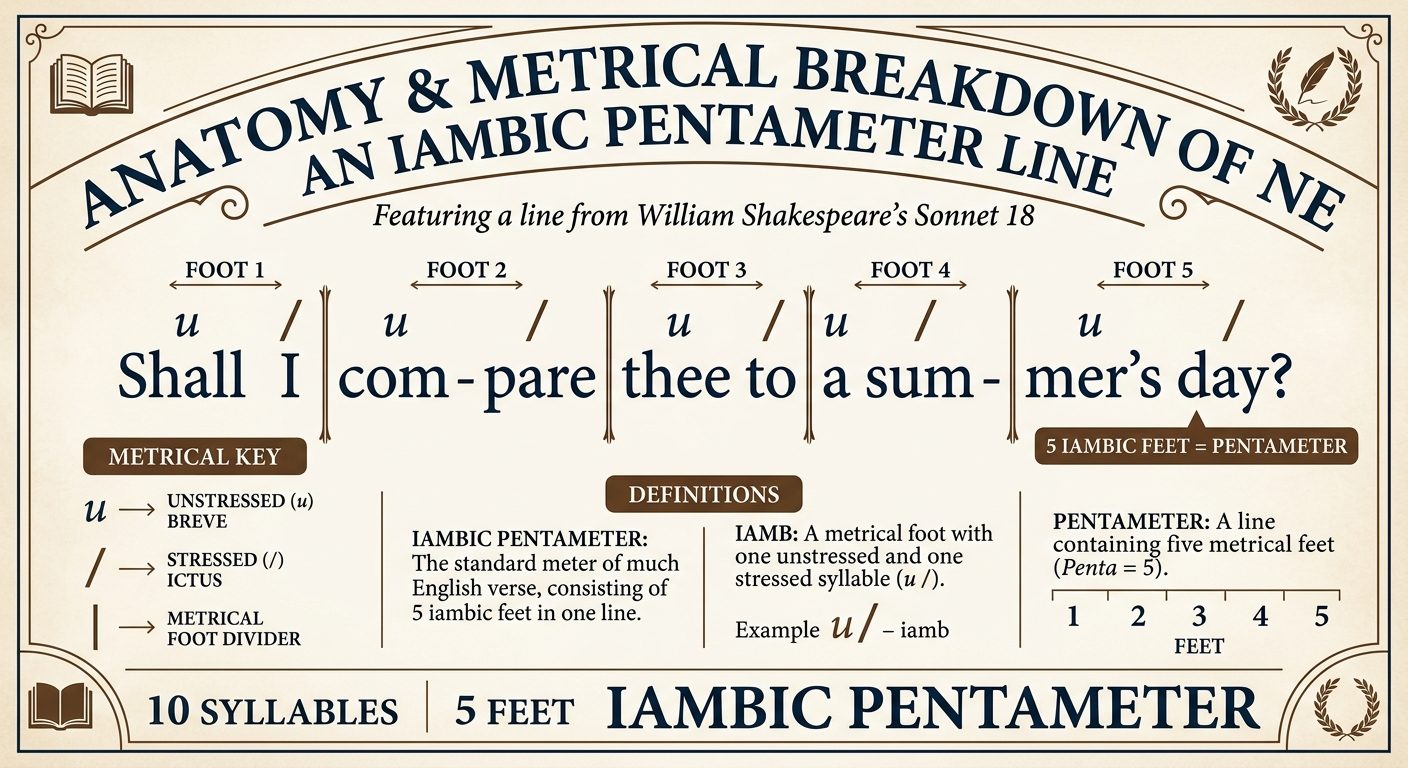
Counting the total number of syllables is useless if you do not understand where the emphasis lies. Scansion is the rigorous analytical process of mapping the poem's metrical feet. You must divide the line into groups of two or three syllables and mark them as either unstressed (˘) or stressed (´).
If your target is iambic pentameter, you need exactly 10 syllables per line, arranged in five pairs of unstressed-stressed beats (da-DUM da-DUM da-DUM da-DUM da-DUM). If you count 10 syllables but the natural spoken emphasis falls on the wrong beats (a trochee or dactyl disrupting the iambs), the poem will feel jagged and unpolished to the reader.
Research on poetic meter and linguistic phonetics is well-documented in Modern Language Association (MLA) style guides on prosody. Understanding the relationship between stress patterns and meaning is critical for professional poetry composition.
5. Algorithmic Verification and Syllable Calculators
Even seasoned editors suffer from "word blindness" after staring at a manuscript for hours, causing their internal monologue to force the rhythm where it doesn't naturally exist. At this stage, you must remove human bias and rely on algorithmic verification.
Using a phonetic database tool guarantees that regional dialects (like pronouncing "fire" as one syllable versus two) do not ruin your universal meter. A digital parser cross-references standard dictionary phonetics to give you a ruthless, objective count.

The Editor's Line-by-Line Verification Checklist
Before finalizing your manuscript or submitting your poem for publication, run it through this strict verification process.
- Isolate the Elisions: Highlight words like "heav'n," "ev'ry," or "o'er." Decide permanently if you are enforcing the contraction or allowing the full syllable count.
- Perform a Scansion Exercise: Take a problem line (e.g., "The lonely mountain casts a jagged shade"). Mark the stresses: (The LONE- | -ly MOUN- | -tain CASTS | a JAG- | -ged SHADE). Verify it is perfectly iambic.
- Check for Spondaic Clutter: Are there too many stressed syllables back-to-back slowing the read down?
- Run the Digital Audit: Stop relying solely on your tired eyes. Use our dedicated Syllable Counter to paste your entire stanza and receive a flawless, mathematical syllable breakdown line-by-line.
Master Your Craft with Linguistic Precision
For deeper exploration of poetic forms and meter, consult the Academy of American Poets (AAP) educational resources which provide comprehensive guides on classical and contemporary poetry techniques.
True poetic mastery comes from understanding both the musical and linguistic dimensions of your work. By combining the methods outlined here with consistent practice and our Syllable Counter tool, you will develop the precision necessary to write metrically flawless poetry that resonates with readers.