6 Master Scansion Rules to Decode Poetic Meter Feet and Perfect Verse Structure
Whether analyzing classical Shakespearean sonnets, modern lyrical music, or formal verse, mastering scansion is the foundation of poetic analysis. Scansion is the process of scanning a poem to identify its rhythmic structure, marking stressed and unstressed syllables, and grouping them into metrical units known as poetic meter feet.
Without scansion, verse can seem arbitrary or chaotic. By applying systematic scansion rules, poets and literary analysts reveal the underlying musical cadence, emotional pacing, and structural symmetry crafted by the author.
In this guide, we break down the core foot classifications, provide a clear stress-notation system, and outline 6 essential scansion rules to decode any poetic line with precision.
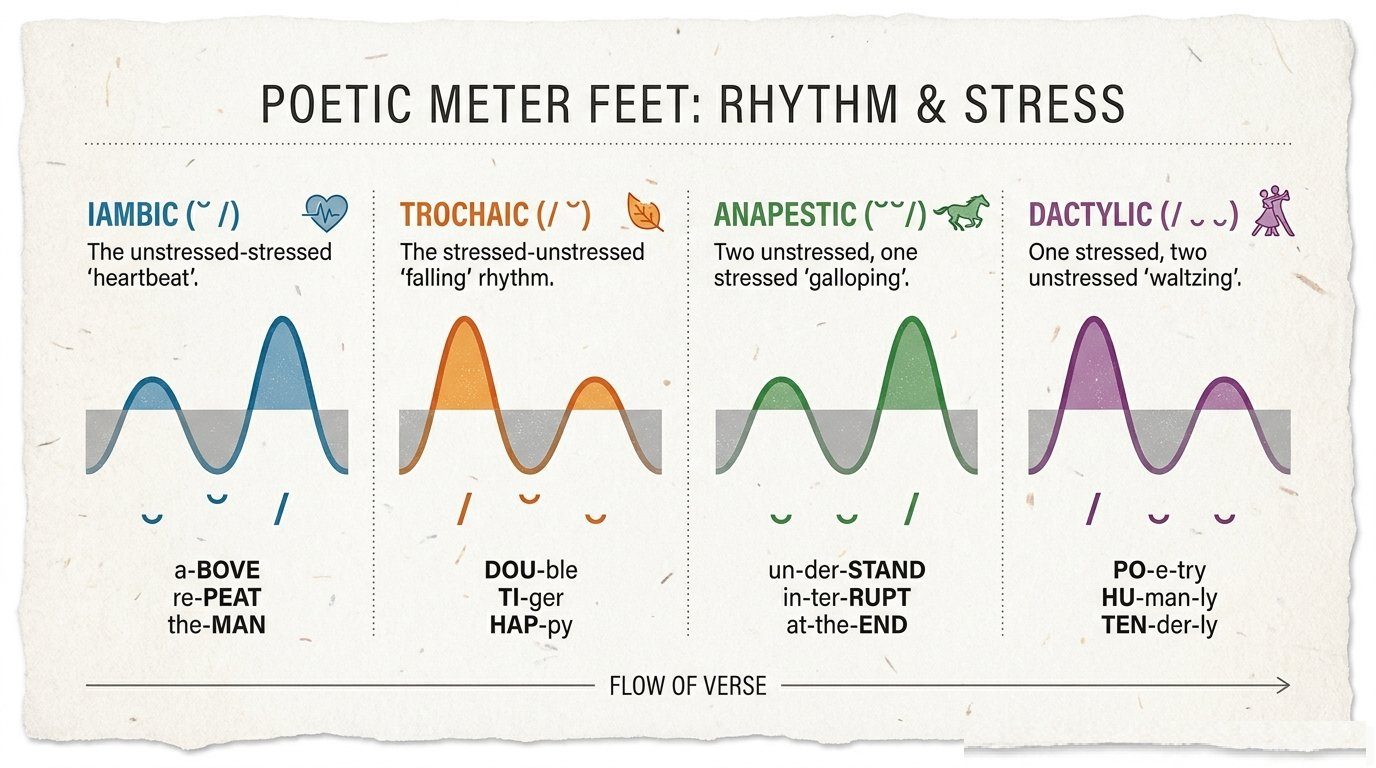
Quick Answer / Key Takeaways * What is Scansion: Scansion is the visual mapping of stressed (´) and unstressed (˘) syllables to determine a line's metrical pattern. * The 4 Primary Feet: The most common feet in English poetry are the Iamb (˘ ´), Trochee (´ ˘), Anapest (˘ ˘ ´), and Dactyl (´ ˘ ˘). * Line Length Notation: A line's meter combines its foot type with foot count (e.g., five iambs equal iambic pentameter).
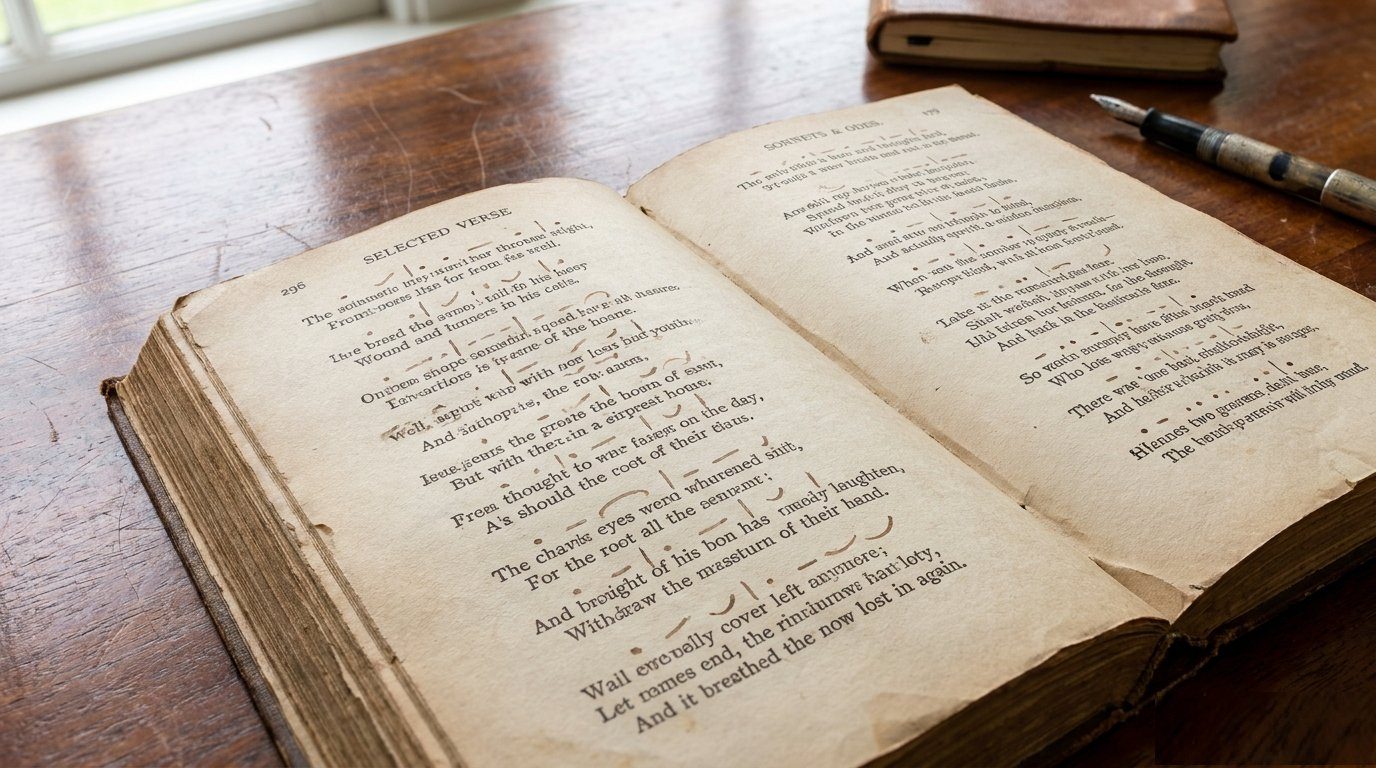
Understanding Scansion & Metrical Feet Mechanics
English poetry is predominantly accentual-syllabic, meaning meter depends on both the total syllable count per line and the regular arrangement of vocal accents (stress).
When scanning verse, rhythmic units are separated by vertical bars (|) called foot dividers. A stressed syllable carries higher vocal pitch, greater volume, or longer duration, represented by a virgule or slash mark (´). An unstressed syllable carries softer vocal inflection, represented by a breve mark (˘).
When poets vary their base meter—such as inserting a trochee into an iambic line—it creates dramatic emphasis or shifts the tempo of the verse.
Classification of Poetic Meter Feet
Before scanning full lines, familiarize yourself with the four primary metrical feet and the two common substitution feet used in English prosody:
| Foot Name | Stress Pattern | Syllable Count | Rhythmic Feel | Classical Example |
|---|---|---|---|---|
| Iamb (Iambic) | Unstressed Stressed (˘ ´) | 2 Syllables | Rising, natural speech rhythm | Re-mark, De-lay |
| Trochee (Trochaic) | Stressed Unstressed (´ ˘) | 2 Syllables | Falling, driving or urgent | Gar-den, Po-et |
| Anapest (Anapestic) | Unstressed Unstressed Stressed (˘ ˘ ´) | 3 Syllables | Galloping, light, fast-paced | Un-der-stand |
| Dactyl (Dactylic) | Stressed Unstressed Unstressed (´ ˘ ˘) | 3 Syllables | Rolling, classical epic tone | E-le-phant |
| Spondee (Spondaic) | Stressed Stressed (´ ´) | 2 Syllables (Substitution) | Heavy, solemn, emphatic | Heart-break |
| Pyrrhic | Unstressed Unstressed (˘ ˘) | 2 Syllables (Substitution) | Rapid, light weightless transition | in a (in a storm) |
For extended reference tables on metrical variations and historical prosody, review the Poetry Foundation Guide to Prosody and Scansion.
6 Master Scansion Rules to Analyze Verse Structure
Follow these 6 sequential rules to accurately scan lines of verse and identify metrical patterns:
1. Identify Natural Multisyllabic Word Accents
Begin by marking words with two or more syllables based on standard dictionary pronunciation. For instance, in the word "tremble," the stress naturally falls on the first syllable (trem-ble).
2. Mark Monosyllabic Nouns, Verbs, and Adjectives
Single-syllable content words (nouns, main verbs, adjectives) generally receive strong stress, whereas function words (articles, prepositions, conjunctions) usually remain unstressed.
3. Group Syllables into Metrical Units
Examine the sequence of marks across the line and place vertical bar dividers (|) to group syllables into repeating foot patterns (twos or threes).
4. Count the Number of Feet per Line
Count the total number of feet to identify the metrical length: monometer (1 foot), dimeter (2), trimeter (3), tetrameter (4), pentameter (5), or hexameter (6).
5. Identify Metrical Substitutions and Catalexis
Watch for intentional variations. If a trochaic line drops its final unstressed syllable, it is catalectic; if an extra unstressed syllable is added to an iambic line, it is hypermeter.
6. Verify Rhythm by Reading Aloud
Speak the line aloud with natural expression rather than exaggerated sing-song cadence. The natural speech emphasis should align with your scansion marks.
Interactive Scansion Practice & Meter Integration
Consider this famous opening line from Shakespeare's Sonnet 18:
Shall I compare thee to a summer's day
When scanned using our 6 rules, the syllable breakdown yields:
Shall | I com- | pare thee | to a | sum-mer's | day
˘ ´ | ˘ ´ | ˘ ´ | ˘ ´ | ˘ ´
The line consists of 10 syllables divided into 5 iambic feet, formally classified as iambic pentameter.
Master Verse Structure with Precision
To instantly count syllables, analyze word stress, and check line counts for your own poetry, use the free Syllable Counter to paste your entire stanza and receive a flawless, mathematical syllable breakdown line-by-line.
For additional literary theory and prosodic analysis, explore resources from the Academy of American Poets and reference classical prosody guides endorsed by the Modern Language Association (MLA).
By mastering these 6 scansion rules and applying them systematically, you will develop the technical expertise to analyze any poetic form and craft verse with intentional metrical precision.