Rhyme Royal Syllable Counting Formula: 6 Scansion Rules for 7-Line Chaucerian Stanzas and Iambic Pentameter
In the scansion of traditional English formal verse, few fixed stanzaic architectures command the narrative gravity and melodic balance of Rhyme Royal. First introduced into English literature by Geoffrey Chaucer in the 14th century for Troilus and Criseyde and The Parliament of Fowls, and later championed by King James I of Scotland (from whom the form takes its royal name), Rhyme Royal represents a masterclass in poetic proportion. It serves as the bridge between the interlocking terza rima of Dante and the grand ottava rima of the Italian Renaissance.
Mathematically, Rhyme Royal is governed by an unyielding constraint: exactly seven lines of iambic pentameter bound by an interlocking ABABBCC rhyme scheme. This structural geometry creates a distinct rhetorical movement, opening with a balanced quatrain (ABAB) and resolving through an interlocking tercet that concludes with a decisive rhyming couplet (BBCC). Scanning and verifying a Rhyme Royal stanza requires precise phonetic syllable counting, accounting for decasyllabic norms, feminine hypercatalectic endings, elision, and caesural balance.
Quick Answer & Scansion Takeaways:
- Line & Stanza Invariants: Exactly 7 lines per stanza; exactly 10 syllables per line under strict masculine iambic pentameter.
- Total Syllable Constraint: A standard masculine Rhyme Royal stanza contains exactly 70 syllables (\(7 \times 10 = 70\)).
- Rhyme Scheme Architecture: Fixed ABABBCC pattern creating a pivotal central line 4 (the B-rhyme hinge) linking the initial quatrain to the concluding couplet.
- Feminine Ending Allowance: An unstressed 11th hypercatalectic syllable is permissible at line endings, expanding line length to 11 syllables without disrupting metrical foot count.
- Phonetic Counting Tool: Audit your line scansion, vowel clusters, and poetic meter with the Count Syllables scansion engine.
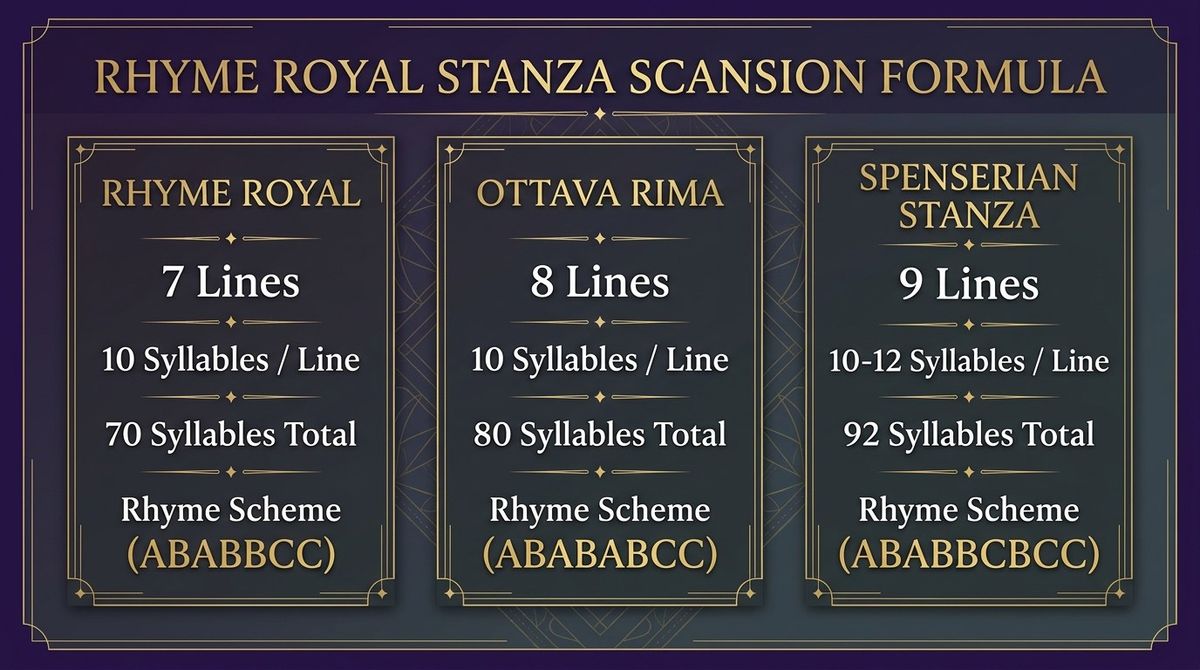
Figure 1: Architectural diagram of a 7-line Rhyme Royal stanza showing the ABAB quatrain, line 4 B-rhyme pivot, and closing CC couplet.
1. The Decasyllabic Line Constraint and Total Stanza Volume
Each individual line in a classical Rhyme Royal stanza consists of iambic pentameter—five successive metrical feet where an unaccented syllable (\(\breve{x}\)) is followed by an accented syllable (\(\bar{x}\)):
\[ \text{Foot} = \breve{x} \, \bar{x} \]The standard line syllable count \(S_{\text{line}}\) is strictly invariant:
\[ S_{\text{line}} = 5 \times 2 = 10\text{ syllables} \]The total syllable count \(S_{\text{stanza}}\) of a complete seven-line masculine stanza is calculated by:
\[ S_{\text{stanza}} = \sum_{i=1}^7 S_{\text{line},i} = 7 \times 10 = 70\text{ syllables} \]If a poet utilizes feminine (hypercatalectic) rhymes on the closing couplet (CC), each feminine line carries 11 syllables:
\[ S_{\text{stanza,fem}} = (5 \times 10) + (2 \times 11) = 50 + 22 = 72\text{ syllables} \]Maintaining exact adherence to this 70-to-72 syllable window is the defining test of authentic formal scansion.
2. The ABABBCC Structural Geometry and the Line 4 Hinge
The genius of Chaucer's design lies in the central structural pivot of Line 4. A Rhyme Royal stanza does not divide into discrete independent halves; rather, its structural sections interlock:
- Lines 1–4 (Quatrain Phase, ABAB): Introduces the narrative premise, proposition, or philosophical theme.
- Line 4 (The Hinge): Concludes the initial B-rhyme while simultaneously anchoring the second rhyme cluster (Lines 4–5, BB).
- Lines 6–7 (Couplet Resolution, CC): Delivers an epigrammatic, dramatic, or philosophical conclusion similar to the final couplet of an Elizabethan sonnet.
The syllable distribution matrix across the three structural rhyme groups is:
\[ S_{\text{Group A}} = S_1 + S_3 = 10 + 10 = 20\text{ syllables (A-rhyme)} \] \[ S_{\text{Group B}} = S_2 + S_4 + S_5 = 10 + 10 + 10 = 30\text{ syllables (B-rhyme)} \] \[ S_{\text{Group C}} = S_6 + S_7 = 10 + 10 = 20\text{ syllables (C-rhyme)} \]This 20-30-20 syllable balance gives the dominant B-rhyme 42.8% of the total acoustic space, establishing melodic continuity across the stanza.

Figure 2: Metrical scansion notation, trochaic substitution rules, and medial caesural pause placement.
3. Phonetic Scansion Rules: Elision, Synaeresis, and Syncope
When auditing syllables in Renaissance and medieval English poetry, orthographic letter count does not equal phonetic vowel pulse count. Scansion poets must apply three classical phonetic adjustment rules:
- Synaeresis: The contraction of two adjacent vowels into a single diphthong within a word (e.g., measuring "heaven" or "power" as one metrical syllable rather than two).
- Syncope: The omission of an unaccented medial vowel between consonants (e.g., "wand'ring" for "wandering", reducing a trisyllabic word to disyllabic meter).
- Elision: The blending of a terminal unstressed vowel with an initial vowel in the succeeding word across a word boundary (e.g., "th' expense" for "the expense").
The net scansion syllable count \(S_{\text{scan}}\) for any given poetic line is expressed as:
\[ S_{\text{scan}} = N_{\text{vowels}} - (N_{\text{diph}} + N_{\text{sync}} + N_{\text{elision}}) + N_{\text{fem}} \]4. Metrical Weight and Scansion Stress Equivalence
While syllable count provides the quantitative foundation, metrical beauty depends on stress equivalence. The total metrical momentum \(M_{\text{line}}\) across the five feet is represented as:
\[ M_{\text{line}} = \sum_{k=1}^5 (\breve{x}_k + \bar{x}_k) \]In masterful Rhyme Royal, poets occasionally execute a trochaic substitution on the first foot (\(\bar{x} \, \breve{x}\)), creating a vigorous opening accent before settling back into iambic rhythm for feet 2 through 5.
5. Fixed Verse Stanzaic Form Comparison Matrix
| Poetic Form | Lines per Stanza | Meter & Line Length | Total Stanza Syllables | Rhyme Scheme Architecture |
|---|---|---|---|---|
| Rhyme Royal (Chaucerian) | 7 Lines | Iambic Pentameter (10 syl) | 70 Syllables | ABABBCC (Interlocking Hinge) |
| Ottava Rima | 8 Lines | Iambic Pentameter (10 syl) | 80 Syllables | ABABABCC (Iterative Alternate) |
| Spenserian Stanza | 9 Lines | 8x Pentameter + 1x Hexameter | 92 Syllables | ABABBCBCC (Concluding Alexandrine) |
| Terza Rima (Tercet) | 3 Lines | Iambic Pentameter (10 syl) | 30 Syllables | ABA BCB CDC (Interlocking Chain) |
| Heroic Couplet | 2 Lines | Iambic Pentameter (10 syl) | 20 Syllables | AA BB CC (Closed Epigrammatic) |
5. Historical Scansion Analysis: Chaucer, James I, and Shakespeare
To appreciate how Rhyme Royal's 70-syllable architecture functions in practice, consider the metrical variation between medieval Chaucerian English and Elizabethan drama. In William Shakespeare's narrative poem The Rape of Lucrece, written entirely in Rhyme Royal, Shakespeare frequently places strong rhetorical pauses (caesuras) precisely at syllable 4 or 6, dividing decasyllabic lines into balanced hemistichs (4+6 or 6+4 syllable units):
From the besieged Ardea all in post, (4 + 6 = 10)
Borne by the trustless wings of false desire, (4 + 6 = 10)
Lust-breathed Tarquin leaves the Roman host (4 + 6 = 10)
This internal structural symmetry balances the acoustic momentum of the stanza, preventing the interlocking ABABBCC rhymes from feeling repetitive across long narrative epics. Analyzing these structural balances with automated syllable scansion tools ensures that modern formal poets preserve true metrical integrity.
6. Standard Operating Verification & Scansion Audit Checklist
- Perform a quantitative vowel-pulse count on all 7 lines to verify each line totals exactly 10 syllables (or 11 with feminine endings).
- Confirm total stanza syllable volume equals exactly 70 syllables under standard masculine scansion.
- Inspect the end-rhyme phonemes to verify strict ABABBCC matching, ensuring Line 4 shares the B-rhyme with Lines 2 and 5.
- Audit line scansion stress markers to ensure primary accents fall on even syllables (2, 4, 6, 8, 10).
- Verify natural caesural pauses occur after syllable 4 or 6, providing rhetorical breathing space for recitative performance.
Verify Your Poetic Meter & Syllables
Analyze poetic line lengths, vowel stress rhythms, and syllable distributions with automated phonetic accuracy.
Launch Count Syllables Tool