Rondeau Syllable Counting Formula: 6 Scansion Rules for 15-Line Lyric Verse and Refrains
Among the classic French fixed forms (formes fixes) that shaped Renaissance and modern lyric poetry, the fifteen-line rondeau occupies a unique middle ground between the compact eight-line triolet and the sprawling nineteen-line villanelle. Immortalized in English literature by John McCrae's 1915 elegy "In Flanders Fields" and Paul Laurence Dunbar's "We Wear the Mask", the classic rondeau is built across three asymmetrical stanzas—a quintet (5 lines), a tercet + refrain (4 lines), and a closing quintet + refrain (6 lines)—governed by strictly two rhyme sounds (\( a \) and \( b \)) and a truncated, unrhymed opening hemistich known as the rentrant refrain (\( R \)).
Because the rentrant refrain repeats only the opening four-syllable phrase of Line 1 rather than the entire line, mastering the rondeau syllable counting formula requires exact control over both full-line iambic tetrameter (8 syllables) and half-line dimeter refrains (4 syllables). In this prosodic scansion guide, we derive the complete 112-syllable and 148-syllable summation equations, dissect McCrae's meter line by line, and detail six rules for auditing rondeau scansion using our CountSyllable Poetic Meter & Syllable Analyzer.
Key Engineering & Financial Benchmarks
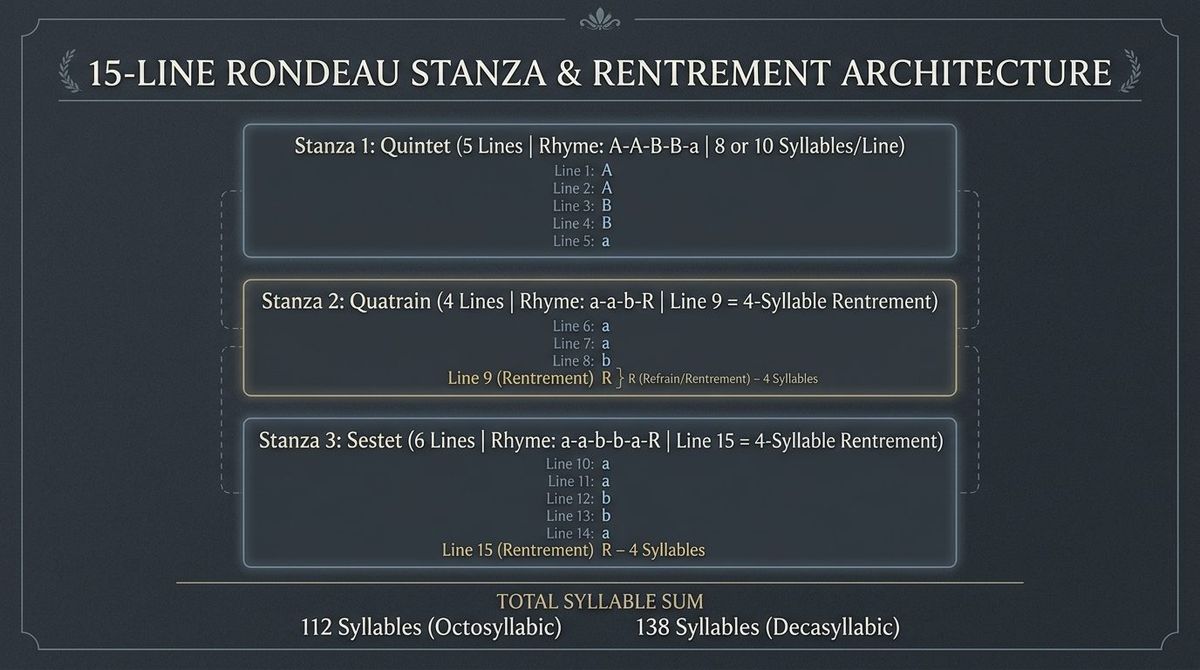
- The 15-Line Three-Stanza Architecture: A classic rondeau comprises 13 full metrical lines plus 2 short rentrant refrain lines (\( 5 + 4 + 6 = 15\text{ lines} \)) following the rhyme scheme
aabba aabR aabbaR.- Tetrameter Total Syllable Formula (\( S_{\text{total}} = 112 \)): In standard English iambic tetrameter (8 syllables per full line, 4 syllables per refrain), total poem syllable count is \( (13 \times 8) + (2 \times 4) = 104 + 8 = \mathbf{112\text{ syllables}} \).
- Pentameter Variant Formula (\( S_{\text{total}} = 138 \)): When authored in decasyllabic iambic pentameter (10 syllables per full line, 4 syllables per refrain), total syllable count expands to \( (13 \times 10) + (2 \times 4) = 130 + 8 = \mathbf{138\text{ syllables}} \).
- The Rentrant Caesura Rule: Line 1 MUST contain a natural syntactic pause (caesura) immediately after its fourth syllable so the opening four-syllable hemistich (\( R \)) can stand alone grammatically at Lines 9 and 15.
1. The 15-Line Stanza Blueprint & Rentrant Refrain Equations
Unlike the villanelle (which repeats an entire 10-syllable line verbatim) or the rondeau redoublé, the classic fifteen-line rondeau derives its musical signature from a rentrant ("re-entering") refrain \( R \) consisting of the first two iambic feet (4 syllables) of Line 1. Let \( L_{\text{full}} \) denote the syllable count of each of the 13 full lines, and \( L_R = 4 \) denote the syllable count of the two refrain lines (Line 9 and Line 15). The total syllable count (\( S_{\text{rondeau}} \)) is given by:
The stanzaic rhyme and syllable distribution unfolds across three distinct movements:
- Stanza 1 (Quintet — Lines 1 to 5): Rhyme scheme
a-a-b-b-a. All 5 lines carry full meter (\( 5 \times 8 = 40\text{ syllables} \)), with the first 4 syllables of Line 1 establishing the rentrant phrase \( R \). - Stanza 2 (Quartet — Lines 6 to 9): Rhyme scheme
a-a-b-R. Lines 6, 7, and 8 carry full 8-syllable meter (\( 3 \times 8 = 24\text{ syllables} \)), while Line 9 drops abruptly to the 4-syllable unrhymed refrain \( R \) (28 syllables total). - Stanza 3 (Sestet — Lines 10 to 15): Rhyme scheme
a-a-b-b-a-R. Lines 10 through 14 carry full 8-syllable meter (\( 5 \times 8 = 40\text{ syllables} \)), and Line 15 concludes with the 4-syllable refrain \( R \) (44 syllables total).
2. Line-by-Line Scansion Audit: John McCrae's 'In Flanders Fields' (1915)
To see how the 112-syllable iambic tetrameter formula operates in a canonical masterpiece, examine the scansion of Stanza 1 and Stanza 2 of John McCrae's "In Flanders Fields" (as archived by the Poetry Foundation):
In FLAN | ders FIELDS. (\( 4\text{ syllables} \)). The sudden halving of line length from 8 syllables to 4 syllables creates an acoustic silence that lingers for two silent metric beats before Stanza 3 begins.
3. Rondeau vs Rondel vs Triolet Scansion Matrix
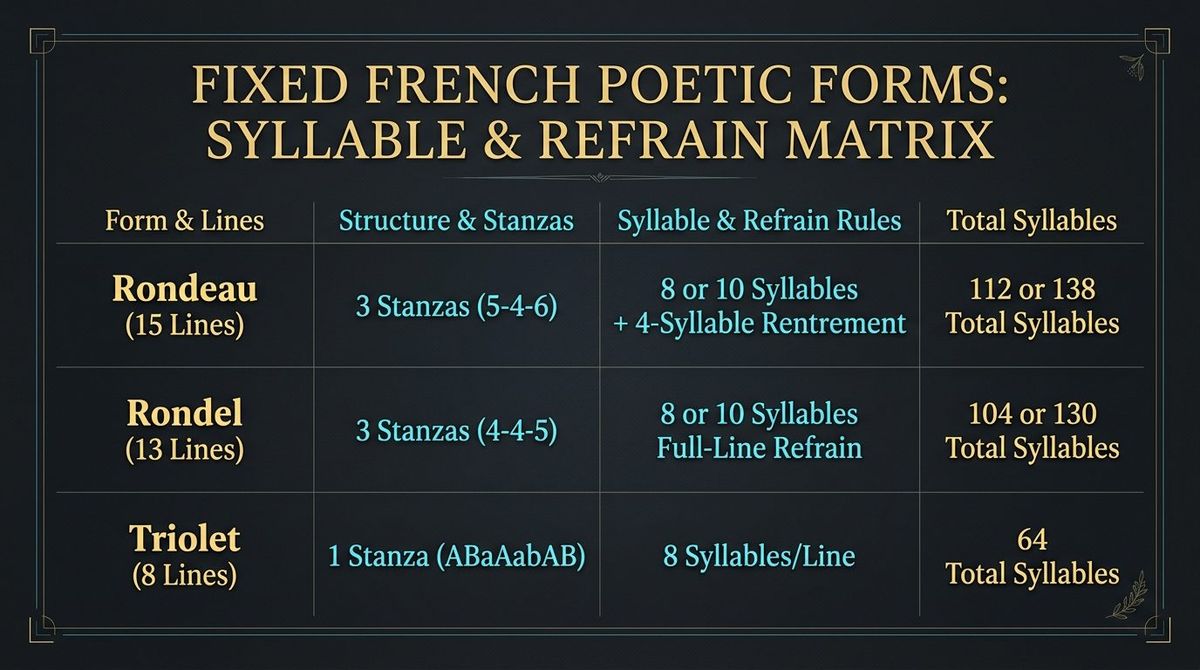
Poets and songwriters on r/Poetry frequently confuse the 15-line rondeau with its medieval cousins, the 13-to-14-line rondel and the 8-line triolet. Compare their exact syllable and refrain formulas below:
| French Fixed Form | Total Lines | Stanza Breakdown | Rhyme & Refrain Scheme | Refrain Length | Tetrameter Syllable Total |
|---|---|---|---|---|---|
| Classic Rondeau | 15 Lines | 5 + 4 + 6 | aabba aabR aabbaR |
4-Syllable Hemistich (\(R\)) | 112 Syllables (104 + 8) |
| Rondeau Prime (Short) | 12 Lines | 7 + 5 | aabbaabR aabbaR (Condensed) |
4-Syllable Hemistich (\(R\)) | 88 Syllables (80 + 8) |
| Rondel | 13 or 14 Lines | 4 + 4 + 5 (or 6) | ABba abAB abbaA(B) |
Full 8-Syllable Lines (\(A, B\)) | 104 or 112 Syllables |
| Triolet | 8 Lines | Single Octet | ABaAabAB |
Full 8-Syllable Lines (\(A, B\)) | 64 Syllables (8 × 8) |
| Villanelle | 19 Lines | 5 × 3 + 4 | A1bA2 abA1 abA2 abA1 abA2 abA1A2 |
Full 10-Syllable Lines (\(A_1, A_2\)) | 152 (Tetra) / 190 (Penta) |
4. The 6 Scansion Rules for Writing & Auditing a 15-Line Rondeau
Before finalizing a 15-line rondeau manuscript, verify all six prosodic constraints:
- Enforce the 4-Syllable Medial Caesura in Line 1: Syllables 1 through 4 of Line 1 must form a self-contained prepositional phrase, noun phrase, or imperative clause (e.g., "In Flanders fields" or "We wear the mask") followed by a natural breath pause. Never split an adjective from its noun across syllable 4 and syllable 5 of Line 1.
- Maintain Strict Iambic Parity (\( \breve{\sigma}\,\acute{\sigma} \)): Every full line must scan to exactly four iambic feet (8 syllables) in tetrameter or five iambic feet (10 syllables) in pentameter. Audit multisyllabic words inside CountSyllable.com to ensure silent -ed and -es suffixes do not add an accidental ninth syllable.
- Keep the Refrain Unrhymed Against 'a' and 'b': The terminal word of the 4-syllable refrain \( R \) (at syllable 4 of Line 1) must NOT rhyme with the end-rhyme of Line 1 (\( a \)) or Line 3 (\( b \)). Its power comes from standing outside the two-rhyme matrix.
- Stockpile 8 Distinct 'a'-Rhyme Words & 5 Distinct 'b'-Rhyme Words: Because the 13 full lines require eight
a-rhymes (Lines 1, 2, 5, 6, 7, 10, 11, 14) and fiveb-rhymes (Lines 3, 4, 8, 12, 13), select open vowel-sonorant rhyme families (such as -ow, -ight, -ay, -ore) before drafting Stanza 1. - Syntactic Enjambment Into Lines 9 and 15: While Line 9 and Line 15 repeat the exact same four syllables as \( R \), link Line 8 into Line 9 and Line 14 into Line 15 with fresh grammar so the refrain shifts from a setting statement in Stanza 1 to a solemn command in Stanza 3.
- Audit Feminine Rhyme Pairs Consistently: If you choose a two-syllable feminine rhyme for your
b-rhyme (adding a 9th unaccented syllable to Lines 3, 4, 8, 12, and 13), apply that hypermetrical 9-syllable count uniformly across all fiveb-lines (\( S_{\text{total}} = 112 + 5 = 117\text{ syllables} \)).
5. Frequently Asked Questions (FAQ)
How many total syllables are in a standard 15-line rondeau?
A standard English rondeau written in iambic tetrameter contains 112 syllables total: 13 full eight-syllable lines (104 syllables) plus 2 four-syllable rentrant refrain lines at Lines 9 and 15 (8 syllables). If written in iambic pentameter, it contains 138 syllables (130 + 8).
Does the short refrain line in a rondeau have to be exactly 4 syllables?
In nearly all strict English and French rondeaux, yes—the rentrant refrain equals the first two iambic feet (4 syllables) of Line 1. Occasional Victorian variations use a single two-syllable iambic foot, reducing total tetrameter syllable count to \( 104 + 4 = 108\text{ syllables} \).
What is the difference between a rondeau and a rondel?
A 15-line rondeau uses a shortened 4-syllable unrhymed phrase (\( R \)) from the start of Line 1 as its refrain at the end of Stanzas 2 and 3, whereas a 13-or-14-line rondel repeats two complete full-length rhyming lines (\( A \) and \( B \)) throughout the poem.
6. Standard Operating Verification & Audit Checklist
Before locking in your final configuration or production parameters for rondeau syllable counting formula, execute this five-point verification protocol across your workspace and accounting records to ensure repeatable field performance:
- Line 1 Fourth-Syllable Caesura Check: Verify that syllables 1 to 4 of Line 1 form a grammatically self-contained hemistich followed by a natural syntactic pause so the rentrant refrain R stands alone cleanly.
- Strict Two-Rhyme Inventory Audit: Confirm that all 13 full lines use exclusively two rhyme sounds (8 'a'-rhymes and 5 'b'-rhymes) while the 4-syllable refrain R remains unrhymed.
- Full-Line Metrical Parity Check: Scan every full line (Lines 1–8 and 10–14) to confirm uniform 8-syllable iambic tetrameter (or 10-syllable iambic pentameter) with zero accidental hypermetrical syllables.
- Refrain Enjambment & Tone Shift: Read Lines 8–9 and Lines 14–15 aloud to verify smooth syntactic flow into both 4-syllable rentrant refrains.
- Automated Scansion Verification: Paste your complete 15-line draft into the CountSyllable Poetic Meter & Syllable Analyzer below to confirm an exact 112-syllable or 138-syllable total.
Model Your Exact Parameters & Tolerances
Run your custom numbers through our interactive engineering and financial calculator to verify your setup in real time.