Rondel 13-Line (ABba abAB abbaA) & Rondel Prime 14-Line Refrain Syllable Counting Formula: Octosyllabic Meter Validator
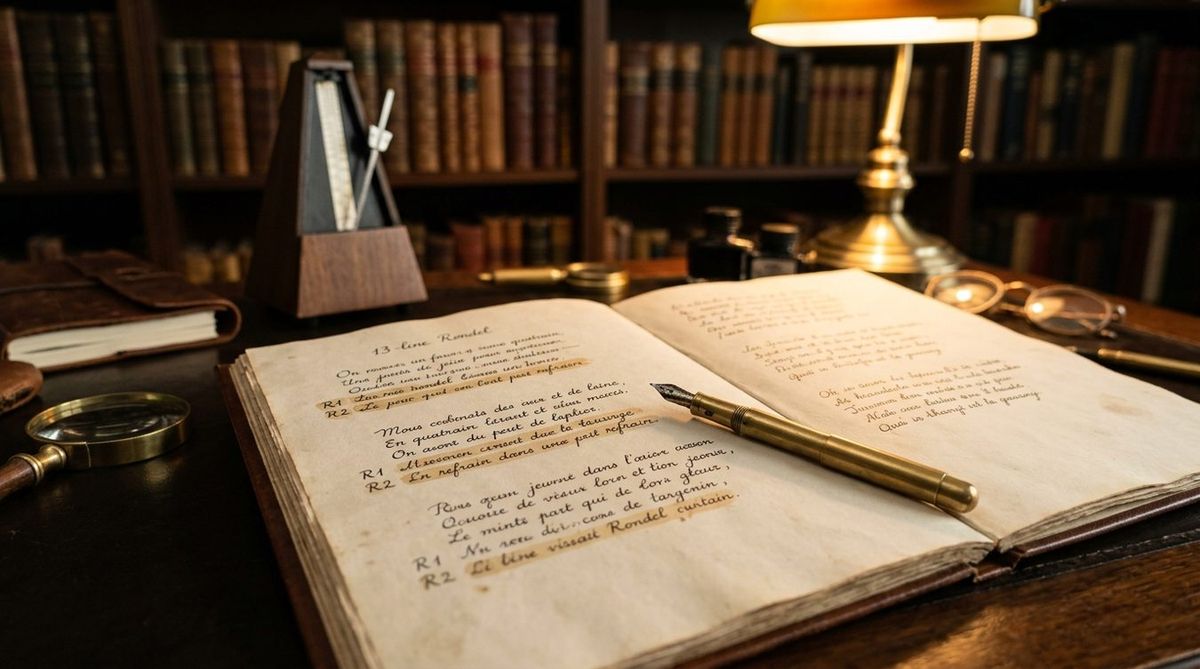
Among the medieval and late-19th-century French fixed poetic forms (formes fixes), the 13-line Rondel (ABba abAB abbaA) and its 14-line Rondel Prime variant (ABba abAB abbaAB) demand strict mathematical symmetry across stanza geometry, rhyme restriction, and syllable-per-line regularity. Poets frequently confuse the 13-line Rondel with the 8-line Triolet (ABaAabAB) or the 15-line Rondeau (aabba aabR aabbaR, where R is a truncated 4-syllable rentrement). In a true Rondel, capital letters (A and B) represent complete, verbatim full-line refrains whose exact syllable count \( S_{\text{line}} \) (traditionally \( S_{\text{line}} = 8\text{ syllables} \) in octosyllabic iambic tetrameter) must match every non-refrain line in the poem. You can validate your draft's line-by-line syllable count and refrain parity automatically at CountSyllable.com.
1. Stanza Architecture & Total Syllable Volume Formula (\( S_{\text{total}} \))
A classical 13-line Rondel is partitioned into three stanzas—two opening quatrains (\( 4\text{ lines} + 4\text{ lines} \)) followed by a closing quintet (\( 5\text{ lines} \))—built exclusively upon two rhyme sounds (a and b):
- Stanza 1 (Quatrain 1 — Lines 1 to 4):
A B b a— Lines 1 and 2 establish the two full-line refrains (\( R_1 = A \) and \( R_2 = B \)), followed by two new lines rhyming with \( B \) and \( A \). - Stanza 2 (Quatrain 2 — Lines 5 to 8):
a b A B— Lines 5 and 6 introduce fresh imagery on rhymesaandb, while Lines 7 and 8 repeat the opening refrain couplet (\( R_1 = A \) and \( R_2 = B \)) word-for-word. - Stanza 3 (Quintet — Lines 9 to 13 in Standard Rondel, or Hexastich Lines 9 to 14 in Rondel Prime):
a b b a A(ora b b a A Bin the 14-line Rondel Prime) — Four new lines in envelopeabbarhyme resolve into a final repetition of Line 1 (\( R_1 = A \)) at Line 13 (plus Line 2, \( R_2 = B \), at Line 14 in Rondel Prime).
Because every line in a classical French or English Rondel carries an identical metrical length of \( S_{\text{line}} = 8\text{ syllables} \) (octosyllabic iambic tetrameter) or \( S_{\text{line}} = 10\text{ syllables} \) (decasyllabic iambic pentameter), the total syllable volume \( S_{\text{total}} \) is strictly deterministic:
\[ S_{\text{total, 13-Line}} = 13\text{ lines} \times 8\text{ syllables/line} = 104\text{ Total Syllables} \quad (130\text{ syllables in pentameter}) \] \[ S_{\text{total, 14-Line}} = 14\text{ lines} \times 8\text{ syllables/line} = 112\text{ Total Syllables} \quad (140\text{ syllables in pentameter}) \]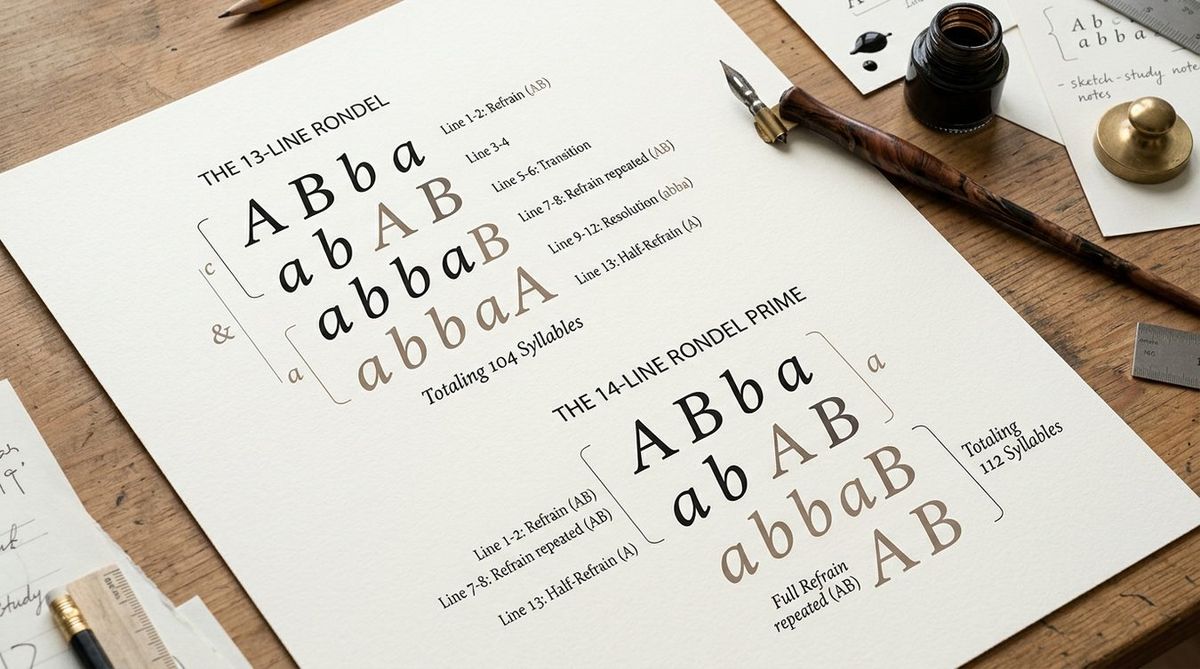
ABba abAB abbaA, 104 octosyllabic syllables) versus the 14-line Rondel Prime (ABba abAB abbaAB, 112 octosyllabic syllables).2. Refrain Burden Density (\( \rho_{\text{refrain}} \)) & Unique-Line Efficiency Math
How much of a Rondel consists of repeated refrain syllables versus newly composed verse? In the 13-line Rondel (ABba abAB abbaA), Refrain 1 (A) appears \( 3\text{ times} \) (Lines 1, 7, and 13) and Refrain 2 (B) appears \( 2\text{ times} \) (Lines 2 and 8), totaling \( L_{\text{ref}} = 5\text{ refrain lines} \) (\( 5 \times 8 = 40\text{ syllables} \)) out of \( 13\text{ total lines} \). However, since Lines 1 and 2 are original when first introduced, the number of unique lines the poet actually writes is only \( L_{\text{unique}} = 10\text{ unique lines} \) (\( 80\text{ unique syllables} \)), with \( 3\text{ echoed lines} \) (\( 24\text{ repeated syllables} \)):
In the 14-line Rondel Prime (ABba abAB abbaAB), both A and B repeat three times (\( L_{\text{ref}} = 6\text{ refrain lines} = 48\text{ syllables} \) out of \( 112\text{ total syllables} \)), raising the refrain density while keeping the unique line count identical at \( L_{\text{unique}} = 10\text{ unique lines} \):
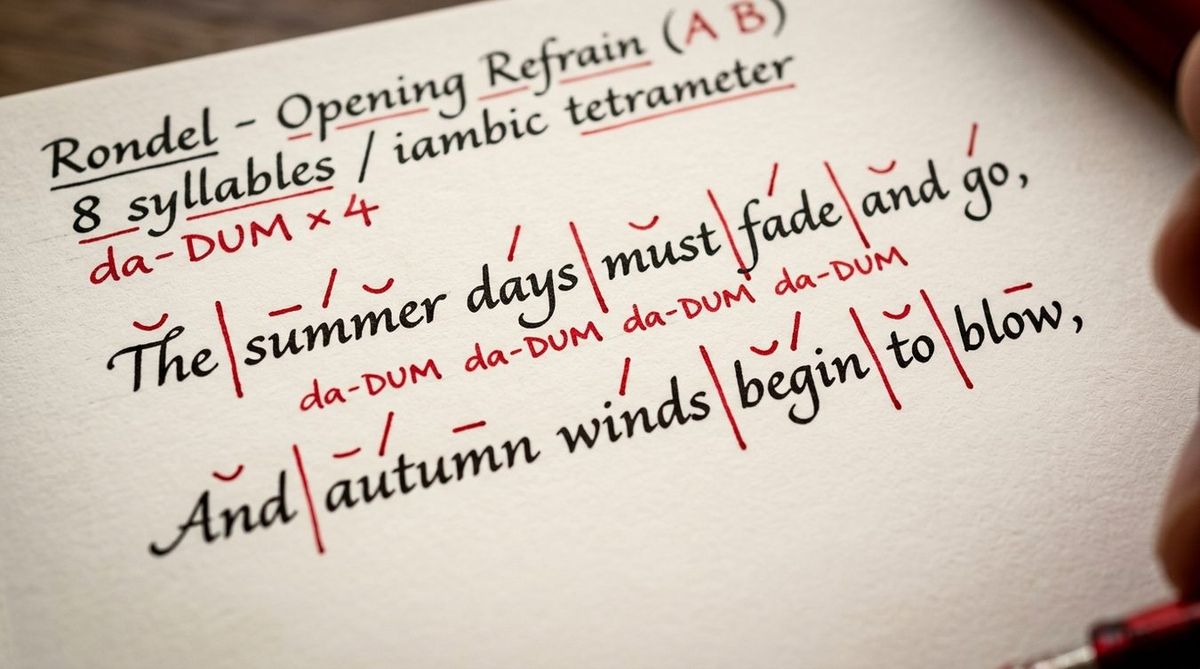
da-DUM x 4 = 8 syllables per line) across the opening refrain couplet (AB) of an English Rondel.3. Scansion Verification: Octosyllabic Iambic Tetrameter (da-DUM × 4)
When adapting the French octosyllabic Rondel into English verse (as practiced by Austin Dobson and Algernon Charles Swinburne), each 8-syllable line is organized into four iambic feet (iambic tetrameter), where each foot pairs one unstressed syllable (u) with one stressed syllable (/):
For example, scanning the opening refrain couplet (A B) displayed in our scansion worksheet confirms strict \( 8\text{-syllable} \) parity:
- Line 1 (\( R_1 = A \)): "The sum-mer days must fade and go," \(\rightarrow\)
The (1) | sum (2) | mer (3) | days (4) | must (5) | fade (6) | and (7) | go (8)\(= 8\text{ syllables}\). - Line 2 (\( R_2 = B \)): "And au-tumn winds be-gin to blow," \(\rightarrow\)
And (1) | au (2) | tumn (3) | winds (4) | be (5) | gin (6) | to (7) | blow (8)\(= 8\text{ syllables}\).
Notice that across all 13 lines (ABba abAB abbaA), rhyme sound a occurs exactly \( 7\text{ times} \) (3 A refrains + 4 a lines) and rhyme sound b occurs \( 6\text{ times} \) (2 B refrains + 4 b lines; or \( 7\text{ times} \) in the 14-line Rondel Prime).
4. French Fixed-Form Syllable & Refrain Comparison Matrix
| Fixed Poetic Form | Total Lines & Stanza Split | Rhyme & Refrain Scheme | Octosyllabic Total (\( S_{\text{total}} \)) | Refrain Burden (\( \rho_{\text{refrain}} \)) |
|---|---|---|---|---|
| Triolet (8-Line) | \( 8\text{ lines} \) (Single Octave) | A B a A a b A B |
\( 64\text{ syllables} \) (\( 8 \times 8 \)) | \( 62.50\% \) (\( 5/8 \) lines) |
| Standard Rondel (13-Line) | \( 13\text{ lines} \) (\( 4 + 4 + 5 \)) | A B b a · a b A B · a b b a A |
\( 104\text{ syllables} \) (\( 13 \times 8 \)) | \( 38.46\% \) (\( 5/13 \) lines) |
| Rondel Prime (14-Line) | \( 14\text{ lines} \) (\( 4 + 4 + 6 \)) | A B b a · a b A B · a b b a A B |
\( 112\text{ syllables} \) (\( 14 \times 8 \)) | \( 42.86\% \) (\( 6/14 \) lines) |
| Rondeau (15-Line) | \( 15\text{ lines} \) (\( 5 + 4 + 6 \)) | a a b b a · a a b R · a a b b a R |
\( 112\text{ syllables} \) (\( 13 \times 8 + 2 \times 4 \)) | \( 13.33\% \) (\( 2\text{ short }R\text{ lines} \)) |
5. Recommended Poetic Composition & Scansion Tools
Curated Literary & Manuscript Hardware for Fixed-Form Poets:
- Tier 1 Distraction-Free Scansion Tablet: reMarkable Paper Pro Color E-Ink Notebook (\( \$579\text{ USD} \)) — Mark stressed and unstressed syllables in red and black ink directly over your 13-line Rondel templates with zero eye strain.
- Tier 2 Literary Manuscript Studio Software: Scrivener 3 + ProWritingAid Studio Bundle (\( \$199\text{ USD} \)) — Side-by-side split-screen binder view for tracking
aandbrhyme banks across multi-poem collections. - Tier 3 Heirloom Vacuum-Filler Fountain Pen: Pilot Custom 823 14k Gold Nib Fountain Pen (\( \$336\text{ USD} \)) — High-capacity \( 2.2\text{ mL} \) ink reservoir for long-form metrical drafting.
Conclusion: Mastering the 13-line Rondel (ABba abAB abbaA) and 14-line Rondel Prime (ABba abAB abbaAB) requires holding every line to a uniform \( 8\text{-syllable} \) (\( 104\text{ or }112\text{ total syllables} \)) or \( 10\text{-syllable} \) (\( 130\text{ or }140\text{ total syllables} \)) meter while weaving two full-line refrains naturally through three stanzas. Paste your draft into our real-time syllable and line validator at CountSyllable.com to verify every line before publication.