Sapphic Stanza Syllable Counting Formula: 6 Scansion Rules for 11-Syllable Hendecasyllabic Lines and the 5-Syllable Adonic
Named after the lyric poet Sappho of Lesbos (c. 630–570 BCE) and later adapted into Latin quantitative verse by Catullus and Horace—and into English accentual-syllabic meter by Algernon Charles Swinburne, Ezra Pound, and Isaac Watts—the Sapphic stanza is one of the most mathematically precise fixed forms in prosody. Unlike standard iambic quatrains that repeat identical 10-syllable lines, the Sapphic stanza pairs three 11-syllable Sapphic hendecasyllabic lines with a rapid, concluding 5-syllable Adonic line (\(11\text{–}11\text{–}11\text{–}5\)).
Whether you are composing original Sapphic odes, translating classical Aeolic lyrics, or auditing poetic meter for an academic manuscript, a single miscounted diphthong or misplaced central dactyl breaks the hypnotic falling cadence of the stanza. Below, we establish the six scansion and syllable-counting formulas for Sapphic verse, which you can test line-by-line in our interactive Count Syllable prosody analyzer.
Quick Sapphic Stanza Architecture & Scansion Summary:
- Line Syllable Vector: Every Sapphic quatrain follows the strict syllable sequence \(\mathbf{s} = (11, 11, 11, 5)\), totaling exactly \(38\text{ syllables per stanza}\).
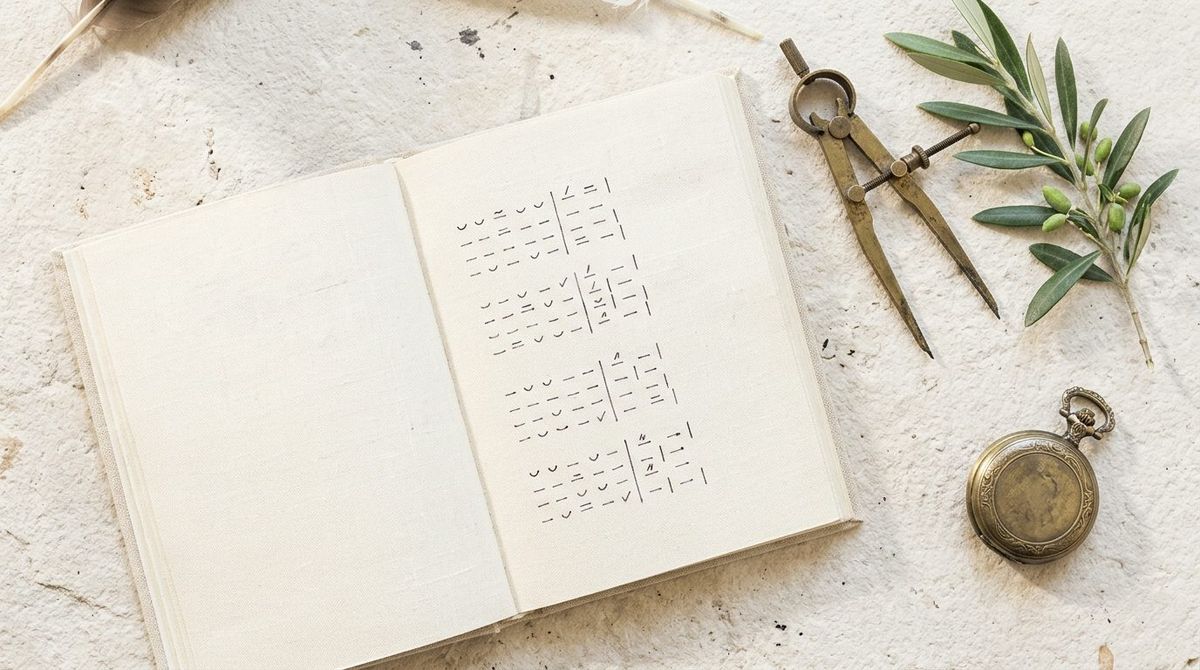
- Lines 1–3 (Lesser Sapphic Hendecasyllable): Composed of 5 metrical feet: Trochee + Trochee + Dactyl + Trochee + Trochee (\(\text{DUM-da} \mid \text{DUM-da} \mid \text{DUM-da-da} \mid \text{DUM-da} \mid \text{DUM-da}\)).
- Line 4 (The Adonic): Composed of 2 metrical feet: Dactyl + Trochee (or Spondee) (\(\text{DUM-da-da} \mid \text{DUM-da}\)), totaling \(3 + 2 = 5\text{ syllables}\).
- Caesura Placement Rule: Place a natural syntactic word boundary (caesura \(\parallel\)) immediately after the 5th syllable (the stressed head of the central dactyl) in Lines 1, 2, and 3.
1. Rule 1: The 38-Syllable Sapphic Quatrain Summation Formula
In a Sapphic poem consisting of \(K\) stanzas, each quatrain \(k \in \{1, 2, \dots, K\}\) contains three hendecasyllabic lines (\(L_{1}, L_{2}, L_{3}\)) of \(11\text{ syllables}\) each and one Adonic fourth line (\(L_{4}\)) of \(5\text{ syllables}\). The total syllable count \(S_{\text{stanza}}\) per quatrain and \(S_{\text{poem}}\) across \(K\) stanzas are governed by:
\[ S_{\text{stanza}} = \sum_{i=1}^{3} S(L_{i}) + S(L_{4}) = \left( 3 \times 11 \right) + 5 = 38\text{ syllables} \] \[ S_{\text{poem}}(K) = 38 \cdot K = 33 \cdot K_{\text{hendeca}} + 5 \cdot K_{\text{adonic}} \]For a standard 6-stanza Sapphic ode (\(K = 6\), \(24\text{ lines}\) total), the complete text must contain exactly \(S_{\text{poem}}(6) = 38 \times 6 = 228\text{ syllables}\), split into \(198\) hendecasyllabic syllables and \(30\) Adonic syllables.
2. Rule 2: Foot-by-Foot Hendecasyllabic Decomposition (\(2+2+3+2+2=11\))
Why does a Sapphic line require exactly \(11\text{ syllables}\) while having only \(5\text{ metrical feet}\) (pentameter)? Because four of the feet are disyllabic (\(2\text{-syllable}\) trochees or spondees) while the third, central foot is a trisyllabic (\(3\text{-syllable}\) dactyl). Let \(n_{\text{T}} = 4\) denote the four trochaic positions (Feet 1, 2, 4, and 5) and \(n_{\text{D}} = 1\) denote the single dactylic position (Foot 3). The line syllable sum \(S(L_{1..3})\) and stressed-to-unstressed ratio are:
\[ S(L_{1..3}) = 2 \cdot n_{\text{T}} + 3 \cdot n_{\text{D}} = 2(4) + 3(1) = 8 + 3 = 11\text{ syllables} \]In English accentual-syllabic Sapphics (where stressed syllables / replace classical long vowels — and unstressed syllables u replace classical short vowels v), the 11-syllable template is:
This produces \(5\text{ stressed beats}\) and \(6\text{ unstressed beats}\) per line (\(5 + 6 = 11\)).
3. Rule 3: The 5-Syllable Adonic Clausula Formula (\(3+2=5\))
The fourth line of every Sapphic stanza—known as the Adonic (named for the ritual lament "Woe for Adonis", \(\text{Ō ton Adōnin}\))—compresses the stanza's rhythmic momentum into a 5-syllable cadence consisting of one Dactyl (\(3\text{ syllables}\)) followed by one Trochee or Spondee (\(2\text{ syllables}\)):
\[ S(L_{4}) = 3_{\text{dactyl}} + 2_{\text{trochee}} = 5\text{ syllables} \qquad \left( \text{/ u u} \mid \text{/ u} \right) \]In classical Greek and Latin Sapphics, the end of Line 3 and the start of Line 4 are metrically linked so closely that a word occasionally splits across the line break (synapheia). In English Sapphics, keep Line 4 as a punchy 5-syllable syntactic phrase that resolves the clause begun in Line 3.

4. Line-by-Line Scansion Audit of Swinburne's "Sapphics"
Let us audit a completequatrain from Algernon Charles Swinburne's famous poem "Sapphics" to see how the \(11\text{–}11\text{–}11\text{–}5\) formula operates in English:
| Line | Scanned Verse Text (Foot Boundaries \(\mid\)) | Foot Breakdown | Syllable Sum |
|---|---|---|---|
| Line 1 | Saw the \(\mid\) white impl-\(\mid\)-or-ing \(\parallel\) hands of \(\mid\) Aph-ro-\(\mid\)-di-te | \(2 + 2 + 3 + 2 + 2\) | \(11\text{ syllables}\) |
| Line 2 | All a-\(\mid\)-round the \(\mid\) throne of \(\parallel\) gold in \(\mid\) heav-en \(\mid\) shin-ing | \(2 + 2 + 3 + 2 + 2\) | \(11\text{ syllables}\) |
| Line 3 | Heard the \(\mid\) voic-es \(\mid\) sing-ing \(\parallel\) through the \(\mid\) twi-light \(\mid\) mea-dows | \(2 + 2 + 3 + 2 + 2\) | \(11\text{ syllables}\) |
| Line 4 (Adonic) | Songs of \(\mid\) Les-bos | \(3 + 2\) (Bright-ly \(\mid\) fall-ing) | \(5\text{ syllables}\) |
5. Rule 4, 5 & 6: Caesura Position, Spondaic Substitution & Elision Traps
- Rule 4 (The 5th-Syllable Masculine Caesura): In Horatian Sapphics, the primary caesura (\(\parallel\)) falls immediately after the 5th syllable (after the stressed first syllable of Foot 3: \(\text{DUM-da} \mid \text{DUM-da} \mid \text{DUM} \parallel \text{da-da} \mid \text{DUM-da} \mid \text{DUM-da}\)), dividing the 11-syllable line into a \(5 + 6\) hemistich ratio. A secondary "feminine caesura" after the 6th syllable (\(6 + 5\) split) is also permitted for rhythmic variety.
- Rule 5 (Second-Foot Spondaic Substitution): While Foot 1, Foot 4, and Foot 5 are trochees (\(\text{/ u}\)), Foot 2 frequently substitutes a heavy Spondee (\(\text{/ /}\), two stressed syllables) to anchor the opening hemistich before the rapid triple-beat dactyl in Foot 3. Crucially, a spondee still contains \(2\text{ syllables}\), so the line total remains locked at \(11\text{ syllables}\).
- Rule 6 (Avoiding Synizesis & Diphthong Miscounts): Watch out for poetic words containing adjacent vowels like "heaven" (\(2\text{ syllables}\), or \(1\) via elision heav'n), "radiant" (\(3\text{ syllables}\):
ra-di-ant), and "fire" (\(1\text{ or }2\text{ syllables}\)). Always run your draft through a phonetic syllable counter to confirm that every hendecasyllable hits \(11\) and every Adonic hits \(5\).
6. Quantitative Classical Length vs English Accentual-Syllabic Adaptation
When comparing original Aeolic Greek Sapphics (composed by Sappho and Alcaeus) or Latin Horatian odes against English Sapphic verse, poets must account for the structural shift from quantitative vowel duration (measuring long — and short v syllable weight by position and diphthong length) to accentual-syllabic stress (measuring loud / and soft u vocal prominence). Because English is a stress-timed Germanic language with fewer natural multi-syllable words ending in unstressed trochaic tails (DUM-da), writing 11-syllable Sapphic lines with feminine (unstressed 11th syllable) endings requires deliberate lexical selection.
To avoid monotonous participle endings (such as repeating "-ing" at the end of every line), alternate two-syllable trochaic nouns ("meadows", "silver", "ocean", "twilight") with compound trochaic phrases where a stressed monosyllabic verb is followed by an unstressed enclitic pronoun or preposition (such as "hold them", "call us", or "under"). This preserves the authentic \(11\text{–}11\text{–}11\text{–}5\) Sapphic pulse while keeping your English diction natural and varied.
Verify Your Sapphic Stanza 11-11-11-5 Syllable Counts Instantly
Paste your Sapphic quatrains into our free phonetic syllable counter to check every 11-syllable line and 5-syllable Adonic before publishing.
Launch the Free Poem & Stanza Syllable Counter →