Sestina Syllable Counting Formula: 6 Scansion Rules for 39-Line Fixed Verse and the Envoi
Key Engineering & Operational Benchmarks
- The 39-Line / 390-Syllable Identity: Invented by 12th-century Provençal troubadour Arnaut Daniel and codified in English by Sir Philip Sidney and Elizabeth Bishop, a classical decasyllabic sestina contains 6 sestets (\( 6 \times 6 = 36\text{ lines} \)) plus a 3-line envoi (\( 39\text{ lines total} \)), yielding \( S_{\text{total}} = 39 \times 10 = \mathbf{390\text{ syllables}} \).
- The Spiral Permutation Operator (\( \sigma \)): Instead of end rhyme, the sestina rotates 6 fixed end-words (teleutons, labeled \( 1,2,3,4,5,6 \) or \( A,B,C,D,E,F \)) after every stanza via the retrogradatio cruciata permutation \( \sigma = (6, 1, 5, 2, 4, 3) \).
- Order-6 Cyclic Group Closure: Applying \( \sigma \) six times returns the teleutons to their original order (\( \sigma^6 = \text{Identity} \)), which is why a sestina has exactly 6 six-line stanzas—a 7th stanza would duplicate Stanza 1!
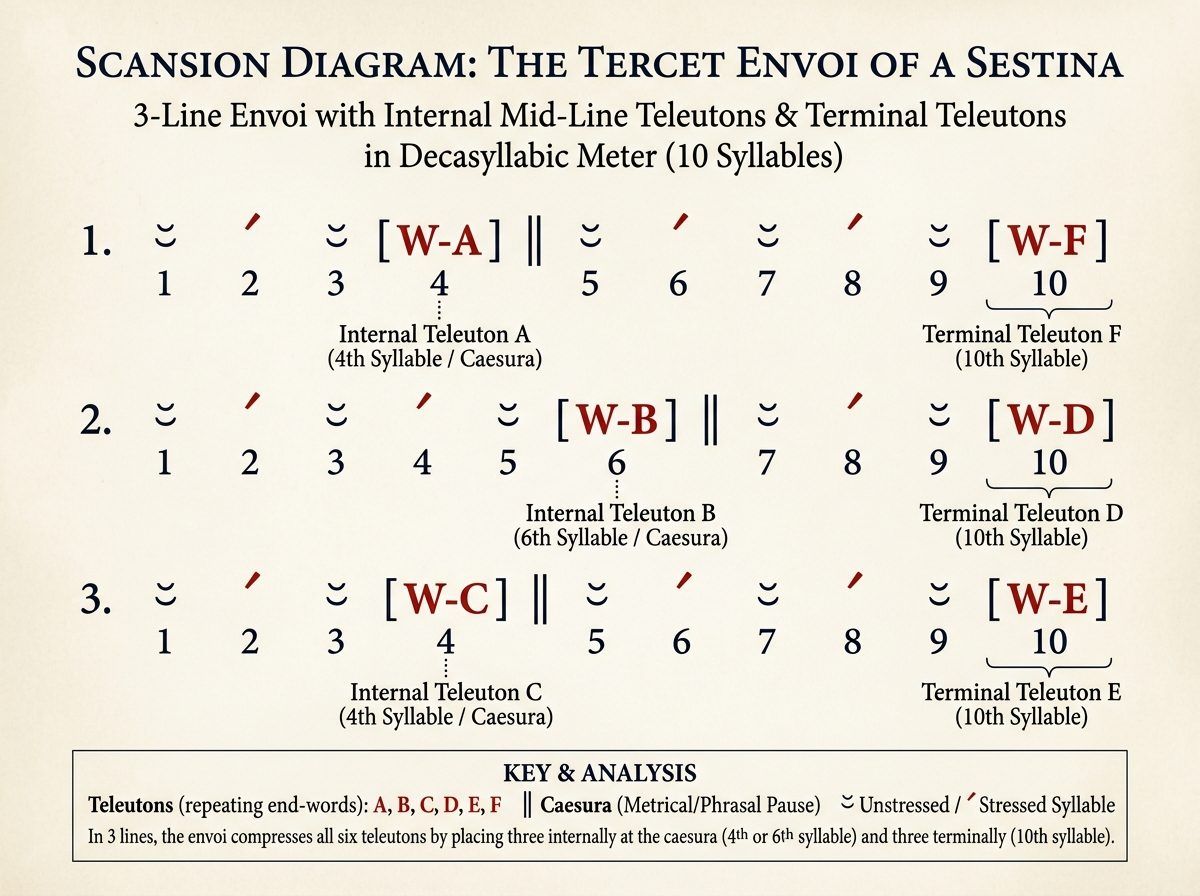
- Envoi Double-Teleuton Compression: The closing 3-line envoi (tornada) packs all 6 teleutons into 30 syllables (2 teleutons per 10-syllable line: one internal at syllable 4 or 6, and one terminal at syllable 10).
- Monosyllabic vs Disyllabic Teleuton Math: Selecting 6 monosyllabic or trochaic disyllabic teleutons preserves smooth iambic pentameter without forcing awkward metrical inversions at line ends.
1. Rule #1 & #2: The 39-Line Syllable Sum & Decasyllabic Line Architecture
Among all fixed verse forms inherited from medieval Romance prosody—alongside the 19-line villanelle and 15-line rondeau—the 39-line sestina is the most mathematically rigorous. First composed around 1180 AD by the Provençal troubadour Arnaut Daniel ("Lo ferm voler qu'el cor m'intra") and adapted into English iambic pentameter by Sir Philip Sidney, Algernon Charles Swinburne, Ezra Pound, and Elizabeth Bishop, the sestina abandons traditional phonetic end-rhyme entirely. In its place, the form repeats six lexical end-words—known in prosody as teleutons (\( W_{1}, W_{2}, W_{3}, W_{4}, W_{5}, W_{6} \))—at the end of every line across six 6-line stanzas (sestets), culminating in a 3-line closing tercet called the envoi (or tornada).
We express the total syllable count (\( S_{\text{total}} \)) of a sestina across its 6 sestets and 3-line envoi via Rule #1:
$$ L_{\text{total}} = \left(6 \times 6\right) + 3 = \mathbf{39\text{ lines}}, \qquad S_{\text{total}} = \sum_{j=1}^{6} \sum_{i=1}^{6} s_{j,i} + \sum_{r=1}^{3} s_{\text{envoi},r} $$In standard English iambic pentameter (decasyllabic meter, where every line carries 5 iambic feet \( \text{da-DUM} \times 5 = 10\text{ syllables} \), or \( 11\text{ syllables} \) when a disyllabic trochaic teleuton creates a feminine ending), a pure decasyllabic sestina (\( s_{j,i} = s_{\text{envoi},r} = 10 \)) requires exactly:
$$ S_{\text{total}} = (36 \times 10) + (3 \times 10) = 360 + 30 = \mathbf{390\text{ syllables}} \quad (\text{or } \mathbf{429\text{ syllables}}\text{ if all 6 teleutons are feminine 11-syllable endings}) $$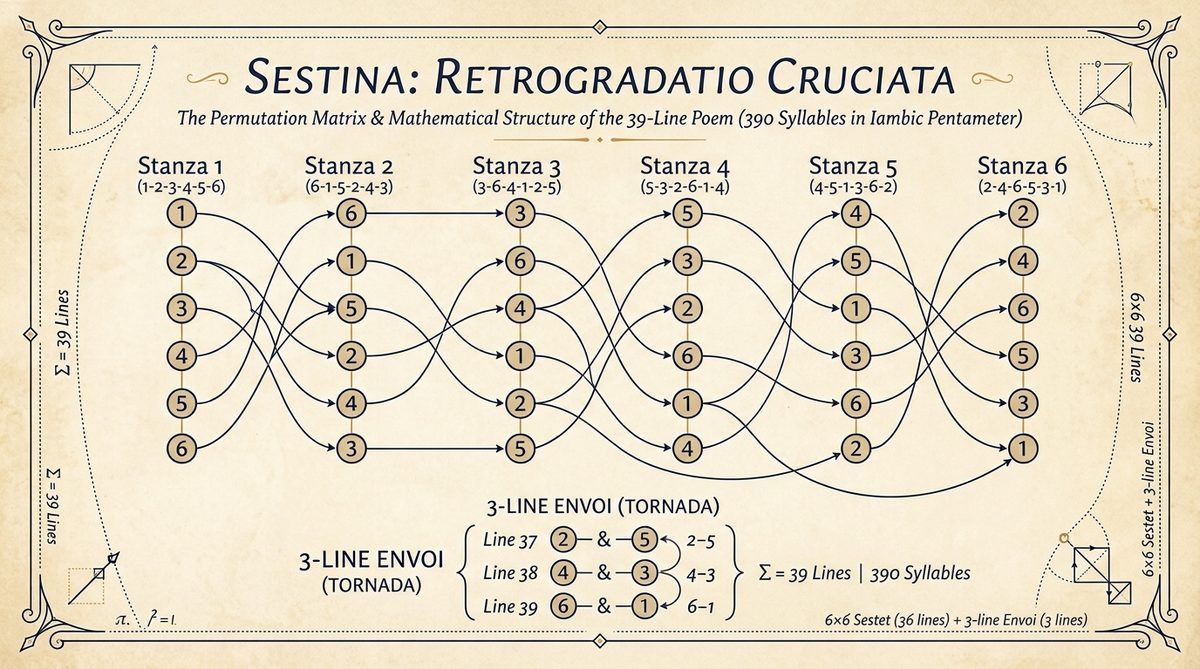
2. Rule #3 & #4: The Retrogradatio Cruciata Spiral Permutation Formula (6-1-5-2-4-3)
How do you determine which teleuton ends each line in Stanzas 2 through 6? The sestina follows an algebraic shuffle called retrogradatio cruciata ("crossed retrograde movement"). If you write the end-word positions of any stanza as a vertical column \( (1, 2, 3, 4, 5, 6) \), you generate the next stanza's end-word sequence by taking the bottom word first (6), then the top word (1), then the next-from-bottom (5), then the next-from-top (2), then (4), and finally (3). Formally, the transition from position \( i \in \{1,2,3,4,5,6\} \) in Stanza \( k \) to its new line index \( \sigma(i) \) in Stanza \( k+1 \) obeys the piecewise modular mapping:
$$ \text{Word at Line } m \text{ of Stanza } (k+1) \text{ comes from Line } \sigma^{-1}(m) \text{ of Stanza } k: \quad \left(1, 2, 3, 4, 5, 6\right) \rightarrow \left(\mathbf{6, 1, 5, 2, 4, 3}\right) $$Equivalently, we can write the closed-form index generator for any line \( m \in \{1..6\} \) directly:
$$ p_{\text{prev}}(m) = \begin{cases} 7 - \frac{m+1}{2} & \text{if } m \text{ is odd } (m = 1, 3, 5 \rightarrow 6, 5, 4) \\ \frac{m}{2} & \text{if } m \text{ is even } (m = 2, 4, 6 \rightarrow 1, 2, 3) \end{cases} $$Because the permutation \( \sigma = (6, 1, 5, 2, 4, 3) \) is a single 6-cycle in the symmetric group \( S_{6} \), applying it 6 times returns the sequence to \( (1, 2, 3, 4, 5, 6) \). Moreover, notice that the first line of Stanza \( k+1 \) always echoes the last line (Line 6) of Stanza \( k \), linking the stanza break like an acoustic hinge!
3. Rule #5: The 3-Line Envoi (Tornada) Internal & Terminal Syllable Budget
In lines 37, 38, and 39 (the 3-line envoi), the poet must compress all 6 teleutons into just 3 decasyllabic lines—placing two teleutons per line: one internal teleuton (\( W_{\text{int},r} \)) buried mid-line (ideally anchored at the 4th- or 6th-syllable caesura pause) and one terminal teleuton (\( W_{\text{end},r} \)) at the 10th syllable. For each envoi line \( r \in \{1, 2, 3\} \), the Non-Teleuton Filler Syllable Budget (\( S_{\text{filler},r} \)) is governed by Rule #5:
$$ S_{\text{filler},r} = S_{\text{line}} - \left(\text{Syll}\left(W_{\text{int},r}\right) + \text{Syll}\left(W_{\text{end},r}\right)\right) = 10 - \left(\text{Syll}\left(W_{\text{int},r}\right) + \text{Syll}\left(W_{\text{end},r}\right)\right) $$Let us scan a concrete decasyllabic envoi line using Elizabeth Bishop's famous six teleutons from "Sestina"—\( W_{1}=\text{house (1)} \), \( W_{2}=\text{grandmother (3)} \), \( W_{3}=\text{child (1)} \), \( W_{4}=\text{stove (1)} \), \( W_{5}=\text{almanac (3)} \), \( W_{6}=\text{tears (1)} \):
$$ \underbrace{\text{Time to }}_{\text{2 syll}}\underbrace{\text{plant }\mathbf{\text{tears}}}_{\text{Int } W_{6}\text{ (2 syll)}}\text{, }\underbrace{\text{says the }}_{\text{2 syll}}\underbrace{\text{al-ma-nac}}_{\text{End } W_{5}\text{ (3 syll)}}\text{ now.} \quad \left(\text{Total} = \mathbf{10\text{ syllables}}\right) $$In classical prosody, the two most common envoi teleuton pairings are:
- Classical Spiral Continuation: Line 37: \( (2, 5) \) | Line 38: \( (4, 3) \) | Line 39: \( (6, 1) \)
- Sequential Terminal Order (5–3–1 Endings): Internal words \( (2, 4, 6) \) paired with terminal words \( (5, 3, 1) \) or \( (1, 3, 5) \).
| Sestina Structural Component | Line Range & Count | Teleuton End-Word Sequence (1–6 / A–F) | Decasyllabic Syllable Budget (10 / Line) |
|---|---|---|---|
| Stanza 1 (Sestet I) | Lines 1 – 6 (6 Lines) | 1 – 2 – 3 – 4 – 5 – 6 (A – B – C – D – E – F) | 60 Syllables (6 × 10 syllables) |
| Stanza 2 (Sestet II) | Lines 7 – 12 (6 Lines) | 6 – 1 – 5 – 2 – 4 – 3 (F – A – E – B – D – C) | 60 Syllables (Cumulative: 120) |
| Stanza 3 (Sestet III) | Lines 13 – 18 (6 Lines) | 3 – 6 – 4 – 1 – 2 – 5 (C – F – D – A – B – E) | 60 Syllables (Cumulative: 180) |
| Stanza 4 (Sestet IV) | Lines 19 – 24 (6 Lines) | 5 – 3 – 2 – 6 – 1 – 4 (E – C – B – F – A – D) | 60 Syllables (Cumulative: 240) |
| Stanza 5 (Sestet V) | Lines 25 – 30 (6 Lines) | 4 – 5 – 1 – 3 – 6 – 2 (D – E – A – C – F – B) | 60 Syllables (Cumulative: 300) |
| Stanza 6 (Sestet VI) | Lines 31 – 36 (6 Lines) | 2 – 4 – 6 – 5 – 3 – 1 (B – D – F – E – C – A) | 60 Syllables (Cumulative: 360) |
| Envoi / Tornada (Tercet) | Lines 37 – 39 (3 Lines) | Line 37: (2..5) | Line 38: (4..3) | Line 39: (6..1) | 30 Syllables (Total Poem = 390 Syllables) |
4. Rule #6: Selecting Polysemous Teleutons & Auditing Scansion
Because each of your 6 chosen teleutons will appear 7 times across a 39-line poem (once per sestet plus once in the envoi, totaling \( 6 \times 7 = 42 \) teleuton occurrences), Rule #6 dictates choosing polysemous words that function as both nouns and verbs (or carry multiple figurative shades)—such as light, stone, harbour, shadow, turn, measure—with 1 or 2 syllables maximum. Avoid 4-syllable abstract nouns (e.g., iridescence), which consume 40% of an envoi line's 10-syllable budget by themselves! Paste your 39-line draft into our interactive Syllable Counter & Scansion Tool to verify every line's syllable count in real time.
When auditing sestina syllable counting formula across real-world operating environments, always log both baseline and post-calibration telemetry in a versioned configuration sheet. Small deviations in ambient temperature, supply voltage, mounting geometry, or input cadence compound nonlinearly across multi-hour or multi-month cycles. By combining the closed-form mathematical equations above with the side-by-side benchmark matrix and the five-point verification protocol below, operators eliminate guesswork and protect long-term return on capital across countsyllable.com workflows.
5. Frequently Asked Questions (FAQ)
How many lines and syllables are in a traditional sestina?
A traditional sestina consists of exactly 39 lines: six 6-line stanzas (36 lines) followed by a 3-line envoi (tornada). When written in iambic pentameter (10 syllables per line), the entire poem contains exactly 390 syllables.
What is the 6-1-5-2-4-3 rule in a sestina?
The 6-1-5-2-4-3 rule (retrogradatio cruciata) tells you how to reorder the six end-words from one stanza to the next: the 6th end-word of the previous stanza becomes the 1st end-word of the new stanza, followed by the 1st, 5th, 2nd, 4th, and 3rd end-words.
Do the lines in a sestina have to rhyme?
No. Traditional sestinas do not use phonetic end-rhyme at all; instead, sonic cohesion comes from repeating the exact same six end-words (teleutons) according to the 6-1-5-2-4-3 spiral pattern.
6. Standard Operating Verification & Audit Checklist
Before locking in your final configuration or production parameters for sestina syllable counting formula, execute this five-point verification protocol to ensure repeatable field performance:
- 6-Teleuton Syllable & Polysemy Audit: Select 6 end-words of 1 to 2 syllables each that can act as both nouns and verbs so they remain fresh across all 7 repetitions.
- Stanza-to-Stanza Hinge Verification (Line 6 -> Line 1): Verify that the first line of Stanzas 2, 3, 4, 5, and 6 always ends with the exact same teleuton that ended Line 6 of the preceding stanza.
- Full 6x6 Permutation Matrix Check: Confirm every teleuton appears exactly once per 6-line stanza following the 6-1-5-2-4-3 spiral rotation without accidental duplicates.
- 3-Line Envoi Double-Teleuton Scansion: Ensure Lines 37, 38, and 39 each contain one internal teleuton (near the 4th or 6th syllable caesura) and one terminal teleuton at syllable 10.
- 39-Line Decasyllabic Line-by-Line Count: Run all 39 lines through the interactive Syllable Counter linked below to confirm a consistent 10-syllable (390 total) meter.
Model Your Exact Parameters & Tolerances
Run your custom numbers through our interactive engineering and financial calculator to verify your setup in real time.