Songwriting Lyric Syllable Per Bar Formula: 6 Essential Rules to Match Vocal Cadence to BPM Tempo
Every songwriter and recording artist has experienced the "lyric-to-beat collision": you write sixteen lines of emotionally charged lyrics in a notebook without an instrument, load up a 120 BPM pop track or a 92 BPM hip-hop instrumental in your DAW, and suddenly discover that Line 1 feels rushed and tongue-tied while Line 2 leaves an awkward two-beat hole of dead air. As lyricists frequently ask in r/WeAreTheMusicMakers BPM-to-syllable threads and r/Songwriting workflow discussions, what is the exact mathematical relationship between a song's tempo in Beats Per Minute (BPM) and the number of syllables that fit comfortably inside a 4/4 bar?
In this complete syllables per bar songwriting formula guide, we bridge music theory and phonetics by deriving the exact equations for 4/4 Bar Duration (\(T_{\text{bar}}\)), Subdivision Syllable Capacity (\(S_{\text{bar}}\)), and Vocal Articulation Velocity (\(S_{\text{sec}}\)) across 8th-note pop melodies, triplet hooks, and 16th-note rap cadences. To audit the syllable count and stress pattern of every line in your verse draft automatically, paste your lyrics into our free Syllable Counter.
Quick Songwriting & Rap Cadence Formulas
- 4/4 Bar Duration in Seconds (\(T_{\text{bar}}\)): $$T_{\text{bar}} = \frac{4 \times 60}{\text{BPM}} = \frac{240}{\text{BPM}} \text{ seconds}$$
- Target Syllables Per 4/4 Bar (\(S_{\text{bar}}\)): $$S_{\text{bar}} = \left( 4 \times k_{\text{sub}} \right) - R_{\text{breath}} - M_{\text{hold}}$$ where (\(k_{\text{sub}} = 2\)) (8th-note pop), (3) (triplet flow), or (4) (16th-note rap).
- Vocal Articulation Velocity Ceiling (\(S_{\text{sec}}\)): $$S_{\text{sec}} = \frac{S_{\text{bar}} \times \text{BPM}}{240} \text{ syllables/sec}$$ Conversational singing sits at 2.5–4.0 syl/sec, pocket rap sits at 4.5–5.8 syl/sec, and chopper double-time exceeds 7.5+ syl/sec.
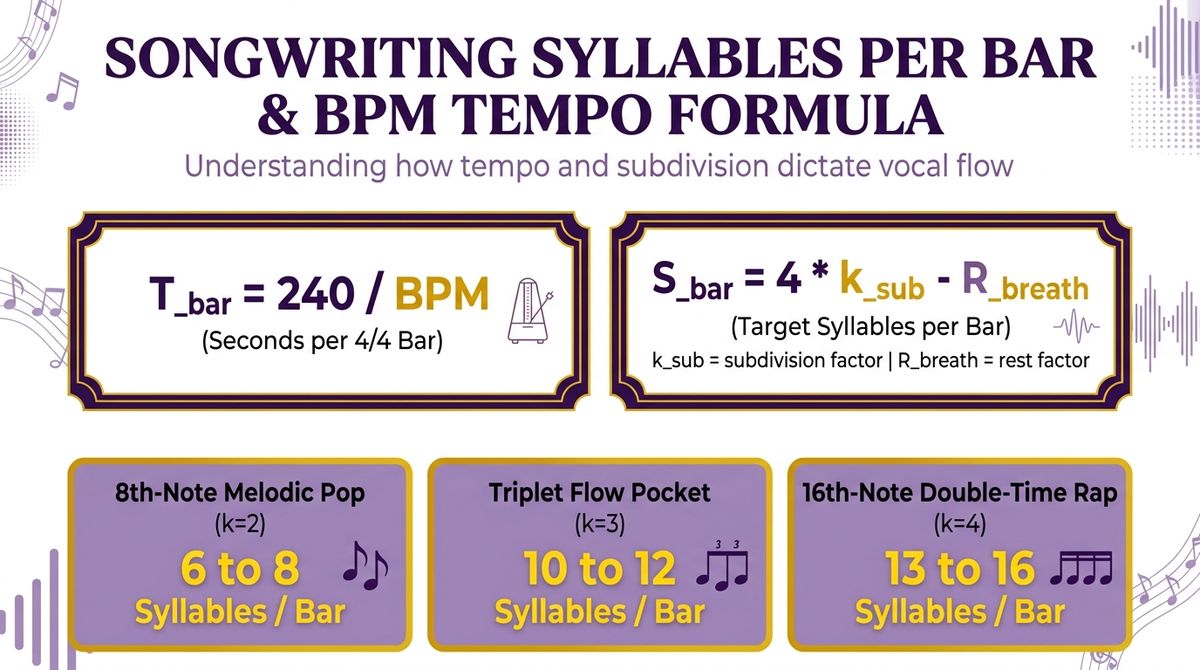
1. Rule 1: Converting BPM Tempo into Exact Bar Duration (\(T_{\text{bar}} = 240 / \text{BPM}\))
When beginners ask how many lines or syllables belong in a verse, the first step is translating abstract musical tempo into physical clock seconds. In standard (4/4) common time, one musical bar (measure) contains exactly 4 quarter-note beats. Since there are 60 seconds in one minute, the duration of a single beat is (\(60 / \text{BPM}\)) seconds, and the duration of a full 4-beat bar is:
Look at how dramatically physical time shrinks as tempo increases:
- 70 BPM R&B / Soul Ballad: (\(T_{\text{bar}} = 240 / 70 = \mathbf{3.43\text{ seconds per bar}}\)). A 16-bar verse lasts 54.9 seconds.
- 92 BPM Classic Boom-Bap Hip-Hop: (\(T_{\text{bar}} = 240 / 92 = \mathbf{2.61\text{ seconds per bar}}\)). A 16-bar verse lasts 41.7 seconds.
- 120 BPM Upbeat Pop / House / Indie Rock: (\(T_{\text{bar}} = 240 / 120 = \mathbf{2.00\text{ seconds per bar}}\)). A 16-bar verse flies by in just 32.0 seconds!
- 140 BPM Trap / Drill (Half-Time Snare on Beat 3): Each single bar is (\(240 / 140 = \mathbf{1.71\text{ seconds}}\)), which is why lyricists group 140 BPM beats into 2-bar half-time couplets lasting 3.43 seconds (feeling identical to a 70 BPM bar).
2. Rule 2: The Subdivision Grid Formula (\(k_{\text{sub}} = 2, 3, 4\))
Once you know how many seconds a bar lasts, how many syllables can occupy that bar? As experienced writers explain in r/Songwriting rhythm tutorials, every syllable you pronounce or sing must land on a rhythmic subdivision of those 4 quarter-note beats. We express total bar capacity via the Songwriting Syllable Density Equation:
Let us define the three variables that govern whether a line grooves effortlessly or chokes the vocalist:
- (\(k_{\text{sub}}\)) (Rhythmic Subdivision Multiplier per Beat): Quarter-Note Anthem Grid (\(k_{\text{sub}} = 1\)): 1 syllable per beat = (\(4\text{ raw slots/bar}\)) (stadium chants and slow chorus hooks). Eighth-Note Melodic Pop/Rock Grid (\(k_{\text{sub}} = 2\)): 2 syllables per beat ( "1-and, 2-and, 3-and, 4-and" ) = (\(8\text{ raw slots/bar}\)). Eighth-Note Triplet Grid (\(k_{\text{sub}} = 3\)): 3 syllables per beat ( "1-trip-let, 2-trip-let, 3-trip-let, 4-trip-let" ) = (\(12\text{ raw slots/bar}\)). Sixteenth-Note Rap / Double-Time Grid (\(k_{\text{sub}} = 4\)): 4 syllables per beat ( "1-e-and-a, 2-e-and-a, 3-e-and-a, 4-e-and-a" ) = (\(16\text{ raw slots/bar}\)).
- (\(R_{\text{breath}}\)) (Inhalation & Phrasing Rest Slots): Human lungs cannot articulate 16 consecutive sixteenth notes bar after bar without gasping for air. Leaving (\(1\text{ to }3\text{ subdivision slots}\)) empty on Beat 4 (or the pickup to Beat 1) gives the listener's ear rhythmic punctuation and lets the vocalist breathe.
- (\(M_{\text{hold}}\)) (Melismatic Vowel Hold Deduction): As songwriters emphasize in r/Songwriting discussions on why lyrics sound like poems , singing stretches single vowel nuclei across multiple beats. Every additional eighth-note a singer holds a long diphthong or open vowel (compare our Haiku Syllable Counting & Diphthong Guide ) consumes (\(1\text{ slot}\)) from (\(S_{\text{bar}}\)).
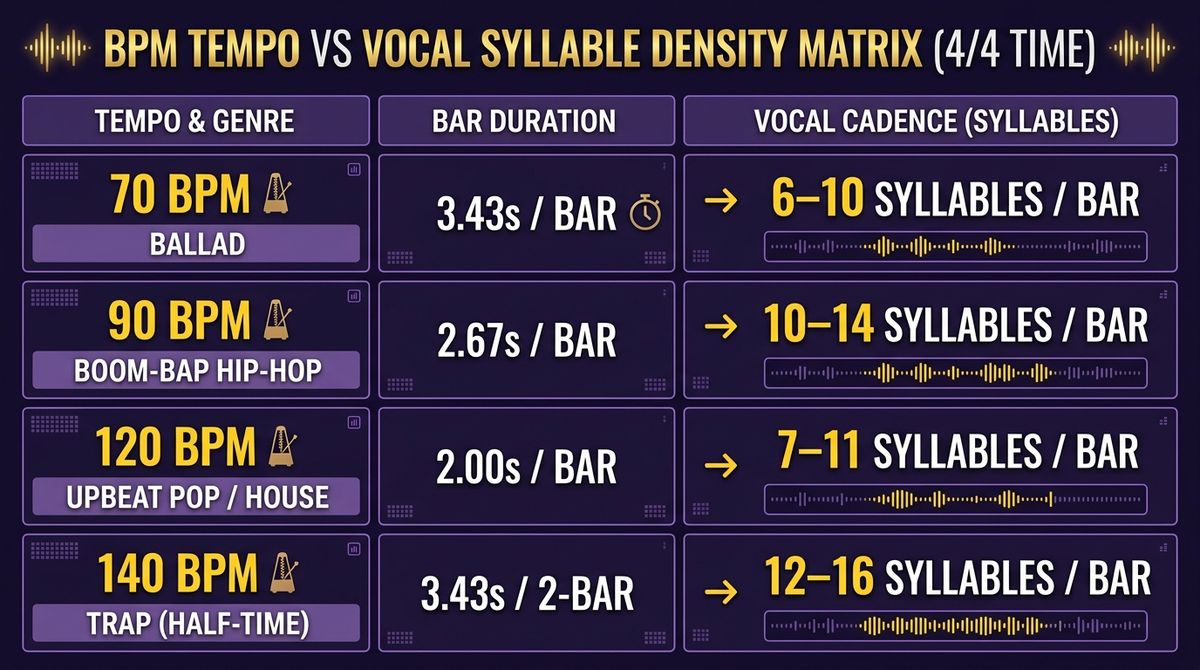
3. Rule 3: Master BPM-to-Syllables Per Bar Lookup Table (70 to 160 BPM)
Use this studio reference chart to match your track's exact BPM and genre to the ideal syllable count per bar (\(S_{\text{bar}}\)) and vocal articulation speed (\(S_{\text{sec}}\)):
| Track Tempo (BPM) | 4/4 Bar Duration (\(T_{\text{bar}}\)) | Primary Subdivision (\(k_{\text{sub}}\)) | Melodic Pop / R&B (\(S_{\text{bar}}\)) | Hip-Hop / Rap Verse (\(S_{\text{bar}}\)) | Articulation Speed (\(S_{\text{sec}}\)) |
|---|---|---|---|---|---|
| 70 BPM (Slow Ballad / Half-Time) | 3.43 sec | 8th / 16th (\(k=2\text{ or }4\)) | 6 – 10 syllables/bar | 12 – 16 syllables/bar | 2.3 – 4.7 syl/sec |
| 85 BPM (Lo-Fi / Neo-Soul) | 2.82 sec | 16th / Triplet (\(k=3\text{ or }4\)) | 7 – 10 syllables/bar | 11 – 15 syllables/bar | 3.9 – 5.3 syl/sec |
| 90 – 95 BPM (Boom-Bap Golden Era) | 2.67 – 2.53 sec | 16th-Note Pocket ((k=4)) | 7 – 9 syllables/bar | 12 – 14 syllables/bar | 4.6 – 5.5 syl/sec |
| 105 BPM (Mid-Tempo Pop / Funk) | 2.29 sec | 8th + Syncopated 16th | 7 – 10 syllables/bar | 10 – 13 syllables/bar | 3.5 – 5.7 syl/sec |
| 120 BPM (Pop / House / Synth) | 2.00 sec | 8th-Note Grid ((k=2)) | 6 – 9 syllables/bar | 10 – 12 syllables/bar | 3.0 – 6.0 syl/sec |
| 140 BPM (Trap / Drill Half-Time) | 1.71s (3.43s / 2-bar) | Triplet / 8th (\(k=2\text{ or }3\)) | 5 – 7 syl/bar (10–14 / 2-bar) | 7 – 9 syl/bar ( 14–16 / 2-bar ) | 4.1 – 5.2 syl/sec |
| 160 BPM (Drum & Bass / Fast Punk) | 1.50s (3.00s / 2-bar) | Half-Time 8th ((k=2)) | 4 – 6 syl/bar (8–12 / 2-bar) | 6 – 8 syl/bar (12–16 / 2-bar) | 4.0 – 5.3 syl/sec |
4. Rule 4: Step-by-Step Worked Examples (92 BPM Rap vs 120 BPM Pop Chorus)
Let us prove why a 13-syllable line that sounds effortless over a 92 BPM boom-bap beat sounds frantic over a 120 BPM pop track:
- Case A — 92 BPM Boom-Bap Hip-Hop Verse (\(k_{\text{sub}} = 4), (R_{\text{breath}} = 3), (M_{\text{hold}} = 0\)): Step 1 (Bar Duration): (\(T_{\text{bar}} = 240 / 92 = \mathbf{2.61\text{ seconds}}\)). Step 2 (Target Syllables): (\(S_{\text{bar}} = (4 \times 4) - 3 - 0 = \mathbf{13\text{ syllables/bar}}\))—matching the exact 13–14 syllable sweet spot reported by hip-hop producers on r/WeAreTheMusicMakers . Step 3 (Articulation Velocity): (\(S_{\text{sec}} = 13 / 2.61 = \mathbf{4.98\text{ syllables/second}}\)) (right in the center of natural English conversational speech at 4.5–5.5 syllables/second).
- Case B — 120 BPM Melodic Pop Chorus (\(k_{\text{sub}} = 2), (R_{\text{breath}} = 1), (M_{\text{hold}} = 1\)): Step 1 (Bar Duration): (\(T_{\text{bar}} = 240 / 120 = \mathbf{2.00\text{ seconds}}\)). Step 2 (Target Syllables): (\(S_{\text{bar}} = (4 \times 2) - 1 - 1 = \mathbf{6\text{ syllables/bar}}\)) (or up to 8 syllables if sung staccato with zero held vowels). Step 3 (Why Poetry Fails Here): If you paste a 10-syllable line from our Shakespearean Sonnet Iambic Pentameter Formula into a 2.00-second pop chorus bar, you force a singer to articulate at (\(5.0\text{ syllables/sec}\)) with zero vowel sustain—turning a soaring hook into rapid-fire patter!
5. Rule 5: Stress-Timed Scansion and the 4-Slash Downbeat Grid
Because English is a stress-timed language (see our 4 Core English Phonetic Syllable Rules), two consecutive bars can have slightly different total syllable counts (e.g., Bar 1 = 11 syllables, Bar 2 = 13 syllables) and still groove seamlessly if and only if their 4 primary stressed syllables land on the 4 quarter-note downbeats.
When editing lyrics in your notebook, draw four vertical slashes (/) per bar representing Beats 1, 2, 3, and 4 (with Beats 2 and 4 marking the snare backbeat). Place your multisyllabic internal rhymes and primary word stresses directly on the slashes, and pack 1 to 3 unstressed pickup syllables (anapests or dactyls) in the pockets between slashes.
6. Rule 6: Consonant Cluster Compression and Elision at High BPMs
When rapping or singing above 5.5 syllables per second, plosive consonant clusters (such as "-kt-", "-str-", or "-ndz-") physically slow down tongue and lip articulation. To maintain clean diction at 13 to 16 syllables per bar: (1) use synaloepha (vowel elision) to merge adjacent unstressed vowels across word boundaries, and (2) favor alternating bilabial (p/b/m) and alveolar (t/d/n) consonants over back-to-back velar stops (k/g).
Count Your Lyric Syllables & Bar Density in Real Time Paste your verse or chorus draft into our free phonetic syllable counter to audit line-by-line syllable totals, vowel nuclei, and meter balance before you hit record. Open the Syllable Counter →
Frequently Asked Questions
How many syllables per bar is normal for a 90 BPM rap beat?
At 90 to 95 BPM, one 4/4 bar lasts 2.53 to 2.67 seconds. On a standard 16th-note cadence (16 slots per bar) with 2 to 4 slots reserved for breath and phrasing rests,12 to 14 syllables per bar (roughly 4.8 to 5.3 syllables per second) is the classic conversational pocket.
Why do my written lyrics feel too long when I try to sing them to a pop beat?
Written poetry typically packs 8 to 11 syllables per line with no held vowels. In a 120 BPM pop song, one bar lasts only 2.00 seconds, and singers sustain key emotional vowels across 1 to 2 beats—leaving room for only 6 to 8 syllables per bar. Trim adjectives and conjunctions until each bar sits under 8 syllables.
How do you count syllables per bar in 140 BPM trap beats?
Because 140 BPM trap beats place the snare on Beat 3 of each bar (half-time feel), producers and vocalists count them in 2-bar phrases lasting 3.43 seconds—equivalent to a 70 BPM bar. Aim for 6 to 8 syllables per single 140 BPM bar (or 12 to 16 syllables per 2-bar couplet).
Run the Interactive Calculator: Use our Syllable Counter & Scansion Tool to model your exact parameters and tolerances in real time.