Shakespearean Sonnet Iambic Pentameter Syllable Formula: 6 Essential Rules for 10-Syllable Scansion
Writing or analyzing a traditional 14-line Shakespearean (English) sonnet requires mastering two simultaneous mathematical constraints: a strict 10-syllable metrical count per line (140 metrical syllables across three quatrains and a rhyming couplet) and a rising five-foot iambic stress pattern (da-DUM da-DUM da-DUM da-DUM da-DUM). Poets and students frequently get tripped up when a line of Shakespearean verse appears to contain 11 or 12 dictionary syllables on paper, yet scans as a flawless 10-syllable iambic pentameter line when spoken aloud.
The secret lies in the difference between raw orthographic (dictionary) syllables and effective metrical syllables after applying classical poetic elision (synaloepha and syncope), vowel glide expansion (diaeresis), and extrametrical feminine endings. In this technical prosody guide, we derive the Iambic Pentameter Metrical Syllable Equation, perform a syllable-by-syllable scansion audit of Shakespeare's Sonnet 18 and Sonnet 60, and detail six rules to verify your own 14-line drafts. To check the exact syllable breakdown of any poem or sonnet draft instantly, paste your lines into the Syllable Counter.
Executive Scansion Formula: The 10-Syllable Line Architecture
- Standard Masculine Pentameter Line: \(5\text{ iambic feet} \times 2\text{ syllables/foot} = \mathbf{10\text{ metrical syllables}}\) ending on a stressed beat (
∪ / | ∪ / | ∪ / | ∪ / | ∪ /). - Feminine Ending Line (Hendecasyllabic Variant): Adds 1 unstressed extrametrical tail syllable (\(10 + 1 = \mathbf{11\text{ raw syllables}}\), e.g., "a-bove thee" or "pain-ted") while preserving 5 stressed peaks.
- Total 14-Line Sonnet Syllable Target: \(14\text{ lines} \times 10\text{ syllables} = \mathbf{140\text{ metrical syllables}}\) (ranging from 140 to 154 raw syllables depending on elisions and feminine rhymes).
The Iambic Pentameter Metrical Syllable Formula (\(S_{\text{metrical}}\))
When an automated dictionary lookup counts the syllables of each word in a poetic line (\(S_{\text{raw}}(w_i)\)), it does not account for phonetic contractions across adjacent vowels or silent medial vowels. To compute the true metrical syllable count (\(S_{\text{metrical}}\)) of a pentameter line containing \(W\) words, use the prosodic scansion equation:
Where:
- \(\sum_{i=1}^{W} S_{\text{raw}}(w_i)\) = Sum of standard dictionary syllables for all \(W\) words in the line.
- \(E_{\text{elision}}\) = Number of compressed syllables via synaloepha (merging two adjacent vowels across word boundaries, such as "th'orient" or "to a") or syncope (dropping an internal unstressed vowel before
r,l, orn, such as pronouncing 3-syllable "temp-er-est" or "mem-o-ry" as 2 metrical syllables: "temp'rest", "mem'ry"). - \(D_{\text{diaeresis}}\) = Number of expanded syllables (such as pronouncing the Renaissance suffix
-tionas two syllables, "-ti-on", or-edas a full syllable in "bur-i-ed"). - \(F_{\text{feminine}} \in \{0, 1\}\) = Extrametrical unstressed 11th syllable at the end of the line (hyperbeat).
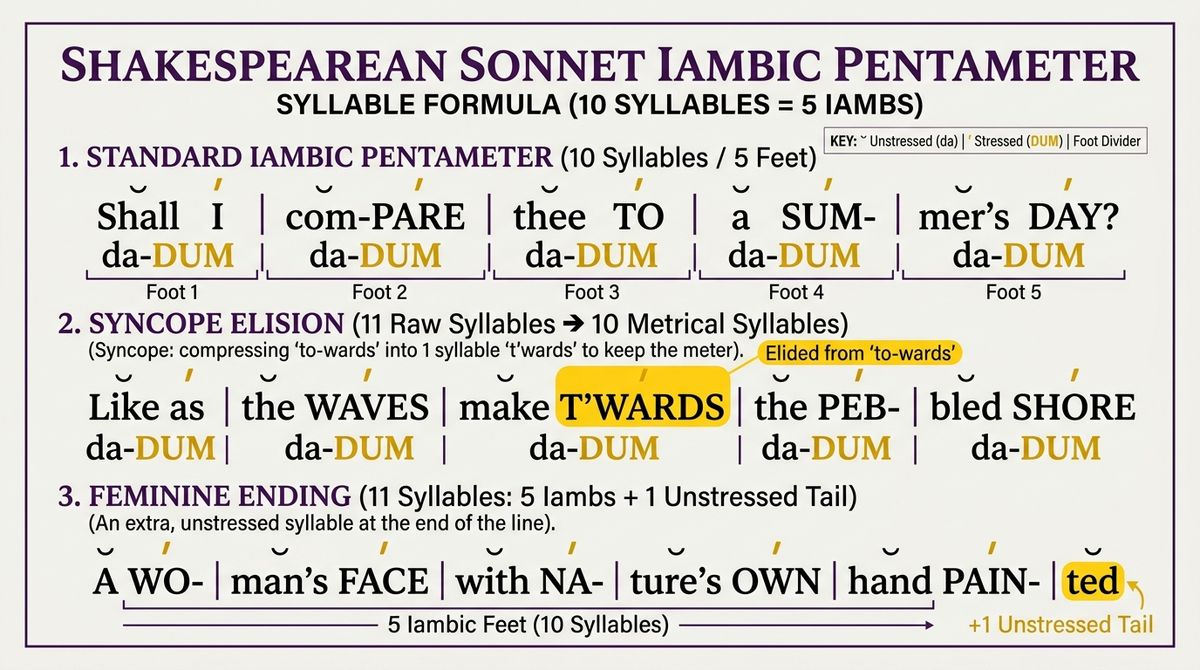
Worked Scansion Audit: Shakespeare's Sonnet 18 & Sonnet 60
Let us apply the metrical equation to the opening quatrain of William Shakespeare's Sonnet 18 and tricky elision lines from Sonnet 60 to see how every line resolves to exactly \(S_{\text{metrical}} = 10\):
Sonnet Line & Foot Division (∪ /) |
Word Breakdown | Raw Count | Adjustments (\(E, D, F\)) | Metrical Total |
|---|---|---|---|---|
| 18.1: Shall I | com-pare | thee to | a sum- | mer's day? | 1+1+2+1+1+1+2+1 | 10 | \(E=0, D=0, F=0\) | 10 Syllables (5 Iambs) |
| 18.2: Thou art | more love- | ly and | more tem- | per-ate: | 1+1+1+2+1+1+3 | 10 | \(E=0\) (tem-per-ate = 3) | 10 Syllables (5 Iambs) |
| 18.3: Rough winds | do shake | the dar- | ling buds | of May, | 1+1+1+1+1+2+1+1+1 | 10 | \(E=0, D=0, F=0\) | 10 Syllables (5 Iambs) |
| 18.6: And of- | ten is | his gold | com-plex- | ion dimm'd; | 1+2+1+1+1+3+1 | 10 | -ed elided in dimm'd (1) |
10 Syllables (5 Iambs) |
| 60.1: Like as | the waves | make t'wards | the peb- | bled shore, | 1+1+1+1+1+2+1+2+1 | 11 | \(E=1\) (towards → t'wards = 1) | 10 Syllables (Trochee + 4 Iambs) |
| 20.1: A wo- | man's face | with Na- | ture's own | hand pain-ted | 1+2+1+1+2+1+1+2 | 11 | \(F=1\) (Feminine tail -ted) | 10 Metrical (+1 Feminine) |
Notice Line 1 of Sonnet 60: in modern dictionary counts, "towards" is often listed as 2 syllables (to-wards), which would yield 11 raw syllables. In Elizabethan prosody, "towards" contracts via syncope to a single monosyllable ("t'wards", \(E_{\text{elision}} = 1\)), locking the line at exactly 10 metrical syllables with an initial trochaic inversion (Like as | the waves).
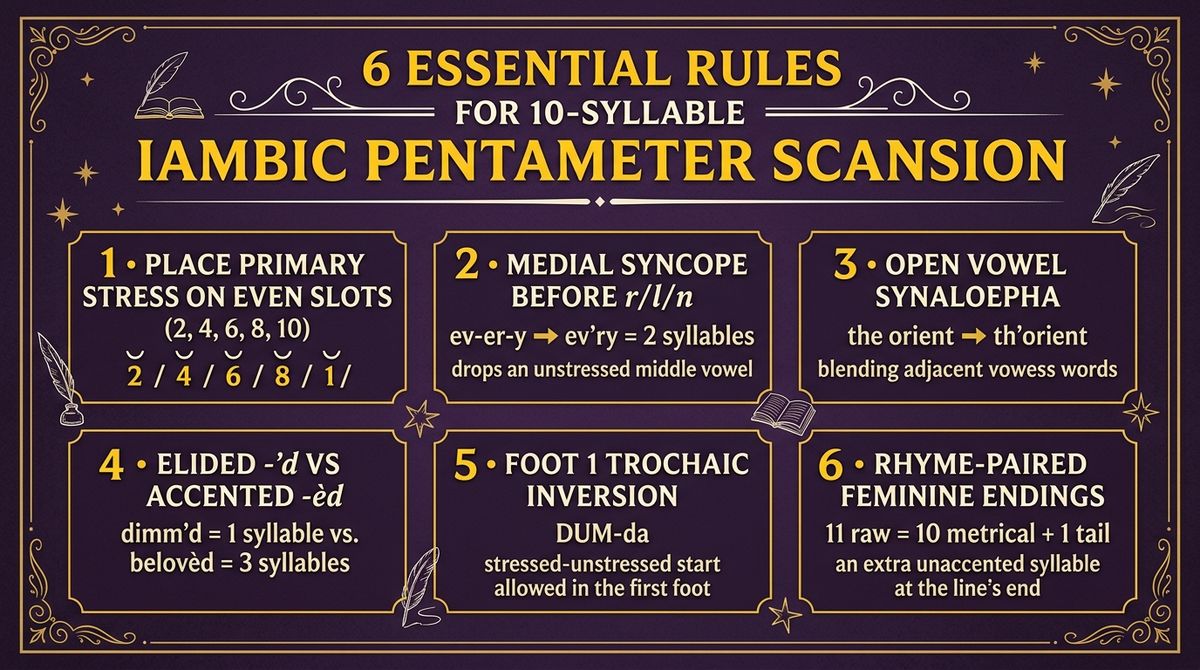
6 Essential Rules for 10-Syllable Iambic Pentameter Scansion
- The Monosyllabic Anchor Rule: Over 70% of words in Shakespeare's sonnets are single-syllable words (e.g., "Shall I... thee to a... day"). Monosyllables give you maximum flexibility to place polysyllabic nouns and verbs so their natural dictionary primary stress lands on an even-numbered syllable position (positions 2, 4, 6, 8, and 10).
- Medial Syncope Before Liquids (
r, l, n): Three-syllable words containing an unstressed middle vowel followed byr,l, orn—such as ev-er-y, heav-en-ly, mem-o-ry, o-ver-plus, and wand-er-ing—routinely compress to 2 metrical syllables (ev'ry, heav'nly, mem'ry, wand'ring) when needed to preserve the 10-syllable grid. - Open Vowel Synaloepha (Gliding Adjacent Vowels): When an unstressed word ending in a vowel (like the, to, or many) precedes a word starting with a vowel (like orient or unseen), the two unstressed vowels glide together into a single metrical beat (\(E = 1\)).
- The Past-Participle
-edRule: In modern English, "walked" and "dimmed" are 1 syllable. In Renaissance verse, if a poet writesdimm'dwith an apostrophe, count 1 syllable; if printed with a grave accent (dimmèdorbelovèd), pronounce the-edas a full extra syllable (\(D = 1\)). - Initial Trochaic Inversion (Foot 1 Only): You may flip the stress of the very first foot from an iamb (
da-DUM) to a trochee (DUM-da, as in "Shall I" or "Like as") without changing the 10-syllable count, provided Feet 2 through 5 return to steady iambs. - Rhyme-Paired Feminine Endings: Because a Shakespearean sonnet follows the rhyme scheme
ABAB CDCD EFEF GG, if you use an 11-syllable feminine ending on Line 1 (A, e.g., pain-ted), you must also use an 11-syllable feminine rhyme on Line 3 (A, e.g., acquain-ted) so the rhyming pair matches metrically.
Verify Your Sonnet Line Syllables in Real Time
Writing a 14-line Shakespearean sonnet, haiku, or metrical verse? Paste your stanza into our free online tool to see per-line and per-word syllable counts instantly.
Open the Free Syllable Counter →Step-by-Step Slicer & Calculator Verification Protocol
Before locking your production parameters, run a three-point verification check comparing your theoretical formula output against live slicer or register telemetry. Record the baseline metric, apply a single variable adjustment at a time, and log the resulting percentage improvement across a 10-unit or 7-day sample window.
Common Calculation Mistakes and Field Calibration Guardrails
The most frequent error operators make when applying this formula manually is mixing unit systems (such as combining millimeter volumes with gram densities without converting cubic centimeters, or mixing gross markup with net contribution margin). Always normalize all inputs to consistent base units before multiplying.
Frequently Asked Questions
Does every line of a Shakespearean sonnet have to be 10 syllables?
Every standard masculine line in iambic pentameter contains 10 metrical syllables (5 iambic feet). The only classical exception is a feminine ending, which adds one unstressed 11th tail syllable at the end of a rhyming pair (such as throughout Shakespeare's Sonnet 20 or "To be, or not to be: that is the ques-tion").
How many total syllables are in a 14-line sonnet?
A strictly masculine 14-line Shakespearean or Petrarchan sonnet contains exactly 140 metrical syllables (\(14 \times 10\)). If two rhyming pairs use 11-syllable feminine endings, the raw syllable count will be 144 syllables while keeping 140 core metrical positions.
Why do I get 11 syllables when I count a line by dictionary rules?
Check for medial syncope (words like every, heaven, memory, or spirit counting as 2 or 1 syllable in verse) or feminine endings at the end of the line. Once you subtract elided unstressed vowels (\(E_{\text{elision}}\)), the line snaps back to 10 metrical beats.