Triolet Syllable Counting Formula: Mastering the 8-Line ABaAabAB Refrain & 64-Syllable Grid
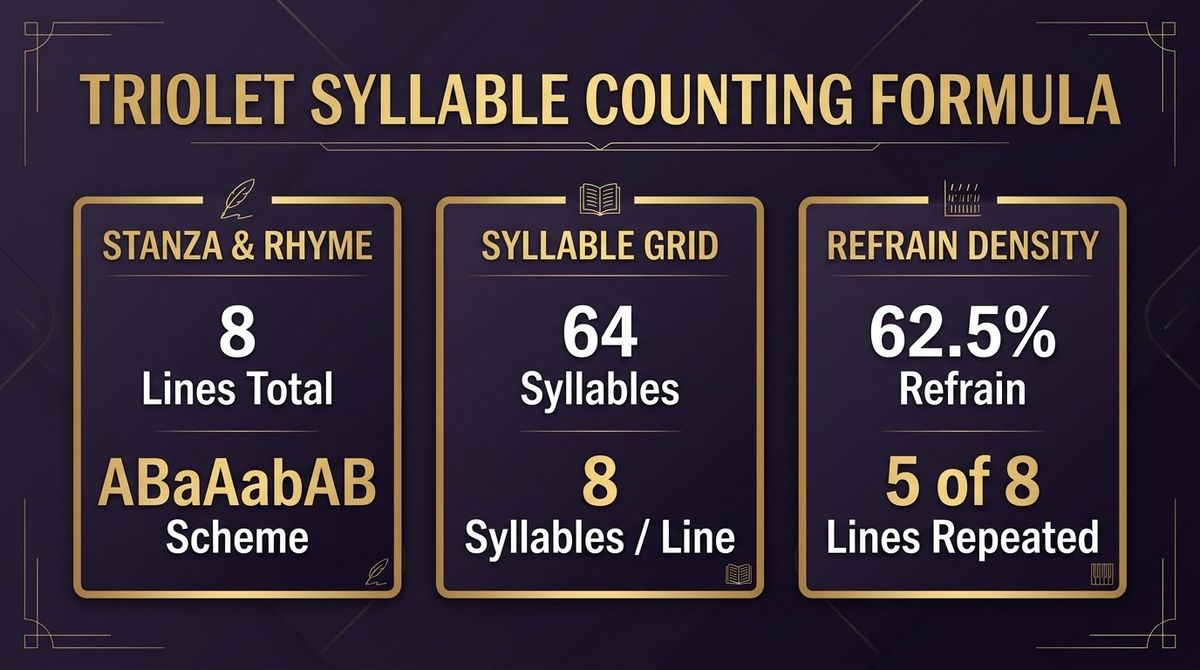
Among fixed French poetic forms—alongside the villanelle, rondeau, and ballade—the Triolet is the most mathematically compressed stanza in English prosody. Consisting of exactly \( 8\text{ lines} \) governed by the strict rhyme and refrain notation \( \text{ABaAabAB} \) (where capital letters denote verbatim repeated refrain lines and lowercase letters denote rhyming non-refrain lines), a classical iambic tetrameter triolet locks into a \( 64\text{-syllable} \) matrix at \( 8\text{ syllables per line} \) \( \left( 4\text{ iambic feet per line} \right) \). Because \( 5\text{ of the }8\text{ lines} \) \( \left( 62.5\% \right) \) are exact repetitions of the opening two lines \( \left( L_1 = L_4 = L_7 \text{ and } L_2 = L_8 \right) \), the poet composes only \( 24\text{ unique syllables} \) across the entire \( 64\text{-syllable} \) poem. This formal scansion guide derives the complete syllable counting equations, refrain density ratios, and metrical stress rules for crafting a flawless triolet.

The Triolet Syllable & Refrain Equivalence Formula
Let \( L = 8 \) represent the total line count of a standard single-stanza triolet, and let \( S_{i} \) denote the phonetic syllable count of line \( i \in \{1, 2, \dots, 8\} \). In canonical English iambic tetrameter \( \left( 4\text{ iambs per line} \times 2\text{ syllables/iamb} = 8\text{ syllables/line} \right) \), total stanza syllable count \( S_{\text{total}} \) is:
\[ S_{\text{total}} = \sum_{i=1}^{8} S_{i} = 8\text{ lines} \times 8\text{ syllables/line} = 64\text{ syllables} \]The defining structural constraint of the triolet is its triple-A and double-B refrain identity across the \( \text{ABaAabAB} \) pattern:
\[ L_{1} \equiv L_{4} \equiv L_{7} \quad \left( \text{Refrain } A \text{ repeated } 3\times \right) \] \[ L_{2} \equiv L_{8} \quad \left( \text{Refrain } B \text{ repeated } 2\times \right) \]Because \( 3 \) lines belong to Refrain \( A \) and \( 2 \) lines belong to Refrain \( B \), the total number of refrain-locked lines is \( N_{\text{refrain}} = 3 + 2 = 5\text{ lines} \), leaving only \( N_{\text{new}} = 8 - 5 = 3\text{ non-refrain lines} \) \( \left( L_3, L_5, L_6 \right) \). This produces a fixed Refrain Density Ratio \( \left( R_{\text{refrain}} \right) \) of:
\[ R_{\text{refrain}} = \frac{N_{\text{refrain}}}{L} = \frac{5\text{ lines}}{8\text{ lines}} = 0.625 \quad \left( 62.5\% \text{ Refrain Density} \right) \]Similarly, the Unique New-Composition Syllable Budget \( \left( S_{\text{unique}} \right) \)—counting \( L_1 \) and \( L_2 \) once when first introduced alongside the three bridge lines \( L_3, L_5, L_6 \)—is only \( 5 \times 8 = 40\text{ distinct syllables} \) (and after the opening couplet \( L_1, L_2 \) is written, the remaining six lines require only \( 3 \times 8 = 24\text{ new syllables} \) while \( 5 \times 8 = 40\text{ of the }64\text{ total syllables} \) belong to the refrain lines).
Line-by-Line Scansion & Rhyme Architecture Table
Every line in the \( 8\text{-line} \) grid serves a distinct syntactic and rhythmic function. Because \( L_4 \) must flow naturally out of \( L_3 \), and the closing couplet \( L_7\text{--}L_8 \) must flow out of \( L_5\text{--}L_6 \), punctuation at the end of the preceding lines determines whether the repeated refrain shifts its semantic tone:
| Line Number | Notation Code | Function & Identity Rule | Iambic Tetrameter Syllables | Cumulative Syllables |
|---|---|---|---|---|
| Line 1 \( \left( L_1 \right) \) | A (Refrain 1) |
Opening statement; establishes the A-rhyme sound and primary refrain | \( 8\text{ syllables} \) \( \left( 4\text{ iambs} \right) \) | \( 8 \) |
| Line 2 \( \left( L_2 \right) \) | B (Refrain 2) |
Completes the opening couplet; establishes the B-rhyme sound | \( 8\text{ syllables} \) \( \left( 4\text{ iambs} \right) \) | \( 16 \) |
| Line 3 \( \left( L_3 \right) \) | a (Bridge 1) |
New line rhyming with \( L_1 \); pivots context into the mid-poem return of \( A \) | \( 8\text{ syllables} \) \( \left( 4\text{ iambs} \right) \) | \( 24 \) |
| Line 4 \( \left( L_4 \right) \) | A (Refrain 1) |
Exact verbatim repetition of Line 1 \( \left( L_4 \equiv L_1 \right) \) | \( 8\text{ syllables} \) \( \left( 4\text{ iambs} \right) \) | \( 32 \) |
| Line 5 \( \left( L_5 \right) \) | a (Bridge 2) |
New line rhyming with \( L_1, L_3, L_4 \); creates the consecutive aAab cluster |
\( 8\text{ syllables} \) \( \left( 4\text{ iambs} \right) \) | \( 40 \) |
| Line 6 \( \left( L_6 \right) \) | b (Turn / Volta) |
New line rhyming with \( L_2 \); sets up the final syntactic twist into \( L_7\text{--}L_8 \) | \( 8\text{ syllables} \) \( \left( 4\text{ iambs} \right) \) | \( 48 \) |
| Line 7 \( \left( L_7 \right) \) | A (Refrain 1) |
Third verbatim appearance of Line 1 \( \left( L_7 \equiv L_1 \right) \) | \( 8\text{ syllables} \) \( \left( 4\text{ iambs} \right) \) | \( 56 \) |
| Line 8 \( \left( L_8 \right) \) | B (Refrain 2) |
Exact verbatim repetition of Line 2 \( \left( L_8 \equiv L_2 \right) \) | \( 8\text{ syllables} \) \( \left( 4\text{ iambs} \right) \) | \( 64\text{ total} \) |
Masculine vs. Feminine End-Rhyme Syllable Variations (64 to 72 Syllables)
While the baseline iambic tetrameter triolet uses masculine endings (ending on a stressed 8th syllable: da-DUM | da-DUM | da-DUM | da-DUM, yielding \( 8 \times 8 = 64\text{ syllables} \)), poets frequently employ hypermetric feminine endings (adding an unstressed 9th syllable, such as "going" / "knowing", on either the A lines or the B lines):
Where \( \delta_{A} \in \{0, 1\} \) indicates whether the five A/a-rhyme lines \( \left( L_1, L_3, L_4, L_5, L_7 \right) \) carry a 9th feminine syllable, and \( \delta_{B} \in \{0, 1\} \) indicates whether the three B/b-rhyme lines \( \left( L_2, L_6, L_8 \right) \) carry a 9th feminine syllable:
- Pure Masculine Iambic Tetrameter \( \left( \delta_A = 0, \delta_B = 0 \right) \): \( 64\text{ total syllables} \) (\( 8\text{ syllables/line} \)).
- Feminine B-Rhymes + Masculine A-Rhymes \( \left( \delta_A = 0, \delta_B = 1 \right) \): \( 64 + 3 = 67\text{ total syllables} \) (as seen in Thomas Hardy's famous "Birds at Winter Nightfall").
- Feminine A-Rhymes + Masculine B-Rhymes \( \left( \delta_A = 1, \delta_B = 0 \right) \): \( 64 + 5 = 69\text{ total syllables} \).
- Pure Iambic Pentameter Variant \( \left( 10\text{ syllables/line} \right) \): \( 8\text{ lines} \times 10\text{ syllables/line} = 80\text{ total syllables} \).

The Enjambment Pivot Technique: Avoiding Monotonous Refrain Echo
Because \( 62.5\% \) of a triolet's lines are identical, the primary craft challenge is preventing \( L_4 \) and \( L_7\text{--}L_8 \) from feeling redundant. Accomplished formalists solve this by writing \( L_1 \) as a syntactic clause that can function both as an independent declarative sentence in \( L_1 \) and as the direct object or subordinate completion of an enjambed verb at the end of \( L_3 \) and \( L_6 \). When auditing your draft in a syllable counter, verify that any punctuation or capitalization changes at the start of \( L_4 \) and \( L_7 \) preserve the exact \( 8\text{-syllable} \) phonetic footprint and stress pattern of \( L_1 \).