Trochaic Tetrameter and Catalectic Syllable Counting Formula: 6 Scansion Rules for 7- and 8-Syllable Verse
While iambic pentameter dominates English blank verse with its conversational rising heartbeat (da-DUM), poets, lyricists, and dramatists turn to trochaic tetrameter whenever they need an immediate, driving, incantatory cadence that launches straight into a stressed downbeat (DUM-da | DUM-da | DUM-da | DUM-da). Yet students, songwriters, and computational prosody parsers frequently stumble over a classic paradox: why do so many famous "trochaic tetrameter" poems—such as William Blake's The Tyger or the Witches' chant in Shakespeare's Macbeth—count out to 7 syllables per line instead of 8? Using our trochaic tetrameter syllable counting formula, you can distinguish complete 8-syllable acatalectic lines from truncated 7-syllable catalectic lines and compute exact stanza syllable budgets.
Whether you are scanning classical verse from Longfellow's The Song of Hiawatha, analyzing Edgar Allan Poe's The Raven, or writing a punchy 4-bar pop/rock chorus that locks onto beats 1, 2, 3, and 4, mastering falling-meter scansion math eliminates awkward rhythmic stumbles. You can verify the exact phonetic syllable count and stress pattern of any line instantaneously with our interactive Syllable Counter & Poetry Scansion Calculator.
Quick Answer — Trochaic Tetrameter Syllable Counting Equations:
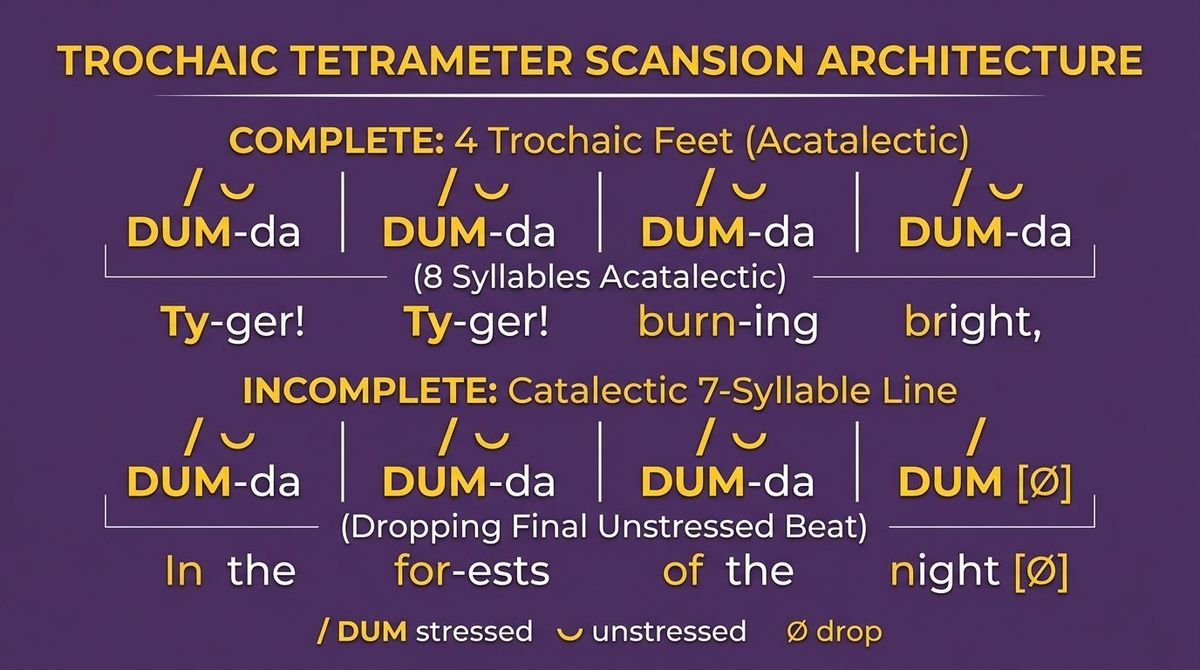
- The Trochaic Foot (\(/ \smile\) or \(\text{DUM-da}\)): A two-syllable falling metrical foot (\(k = 2\)) beginning with a stressed syllable (\(/\)) followed by an unstressed syllable (\(\smile\)).
- Complete (Acatalectic) Trochaic Tetrameter (\(C = 0\)): \(S_{\text{line}} = 4 \times 2 = \mathbf{8\,\text{syllables}}\) (ends on an unstressed feminine syllable, as in Longfellow's Hiawatha).
- Truncated (Catalectic) Trochaic Tetrameter (\(C = 1\)): \(S_{\text{line}} = (4 \times 2) - 1 = \mathbf{7\,\text{syllables}}\) (drops the final unstressed beat so the line lands forcefully on a stressed masculine rhyme, as in Blake's "Ty-ger! Ty-ger! burn-ing bright").
1. The Mathematical Formula for Trochaic Tetrameter & Catalexis
In formal prosody, any disyllabic meter (where each metrical foot contains \(k = 2\) syllables) arranged in tetrameter (\(N_{\text{feet}} = 4\) feet per line) has a baseline syllable count of \(N_{\text{feet}} \times k = 8\). However, trochaic verse frequently employs catalexis—the deliberate omission of the final unstressed syllable at the end of a line (\(C \in \{0, 1\}\)) to create a pause (rest) and allow a strong masculine end-rhyme. The universal line syllable equation (\(S_{\text{line}}\)) and \(M\)-line stanza syllable equation (\(S_{\text{stanza}}\)) are:
Where:
- \(N_{\text{feet}} = 4\) = Four trochaic feet per tetrameter line.
- \(k = 2\) = Two syllables per complete trochee (\(/ \smile\)).
- \(C_i = 0\) for an acatalectic (complete) line of \(8\,\text{syllables}\) ending on an unstressed beat (\(/ \smile \,|\, / \smile \,|\, / \smile \,|\, / \smile\)).
- \(C_i = 1\) for a catalectic (headless/tailless truncated) line of \(7\,\text{syllables}\) ending on a stressed beat followed by a metrical rest (\(/ \smile \,|\, / \smile \,|\, / \smile \,|\, / \, [\varnothing]\)).
2. Worked Scansion Audit: Acatalectic (8) vs. Catalectic (7) Quatrains
Let us apply the formula to two canonical literary examples to see why syllable counts vary between \(28\) and \(32\) syllables per quatrain (\(M = 4\) lines):
Case A — Pure Acatalectic Trochaic Tetrameter (\(C_i = 0 \implies 8\,\text{Syllables/Line}\))
In Henry Wadsworth Longfellow's The Song of Hiawatha, every line retains its final unstressed syllable (\(C_i = 0\)), producing unrhymed feminine endings patterned after the Finnish Kalevala:
Across a 4-line passage where \(C_1 = C_2 = C_3 = C_4 = 0\), total stanza syllables equal \(S_{\text{stanza}} = 8(4) - 0 = \mathbf{32\,\text{syllables}}\).
Case B — Catalectic Trochaic Tetrameter (\(C_i = 1 \implies 7\,\text{Syllables/Line}\))
Now examine the opening stanza of William Blake's The Tyger (from Songs of Experience). Why did Blake drop the 8th syllable on Lines 1, 2, and 3? Because English has far more single-syllable (masculine) rhyme words (bright / night) than two-syllable (feminine) rhyme words, and landing on a stressed syllable gives the line a hammer-like finality:
Summing the quatrain: \(S_{\text{stanza}} = 7 + 7 + 7 + 8 = \mathbf{29\,\text{syllables}}\) (whereas a pure 4-line catalectic quatrain such as Shakespeare's "Dou-ble, dou-ble toil and trou-ble" alternating 8 and 7 syllables yields \(S_{\text{stanza}} = 30\) or \(28\) syllables).
3. Alternating Acatalectic/Catalectic Common-Time Songwriting Math
In contemporary songwriting and musical theatre, pure 8-syllable acatalectic trochaic lines stacked back-to-back can sound breathless because there is zero rest between the final unstressed syllable of Line 1 and the initial downbeat of Line 2. Songwriters solve this by alternating an 8-syllable acatalectic line (\(C_1 = 0\)) with a 7-syllable catalectic line (\(C_2 = 1\)) in \(4/4\) common time:
In \(4/4\) time, each trochee occupies one quarter-note beat (divided into two eighth notes: ONE-and TWO-and THREE-and FOUR-and). On the 7-syllable catalectic line, beat "and" of beat 4 becomes an eighth-note breath rest, giving the vocalist room to inhale before hitting the downbeat of the next bar.
4. Complete Trochaic Tetrameter Stanza & Catalexis Reference Matrix
| Trochaic Tetrameter Variant | Scansion Pattern (\(/ = \text{Stress}, \smile = \text{Unstress}\)) | Catalexis Parameter (\(C_i\)) | Syllables Per Line (\(S_{\text{line}}\)) | 4-Line Quatrain Total (\(S_{\text{stanza}}\)) | Canonical Literary / Lyric Example |
|---|---|---|---|---|---|
| Pure Acatalectic | \(/ \smile \,|\, / \smile \,|\, / \smile \,|\, / \smile\) | \(C_i = 0\) (All lines) | \(8\) syllables | \(32\) syllables | Longfellow, The Song of Hiawatha |
| Pure Catalectic | \(/ \smile \,|\, / \smile \,|\, / \smile \,|\, / \, [\varnothing]\) | \(C_i = 1\) (All lines) | \(7\) syllables | \(28\) syllables | Shakespeare, Love's Labour's Lost ("On a day...") |
| Alternating 8 / 7 Hymn | Line 1: \(8\) (\(/ \smile\)) / Line 2: \(7\) (\(/ [\varnothing]\)) | \(C_{\text{odd}}=0, C_{\text{even}}=1\) | \(8 / 7 / 8 / 7\) | \(30\) syllables | 4/4 Pop/Rock Chorus & Ballad Stanzas |
| Blakean 7-7-7-8 Quatrain | Three Catalectic + 1 Complete/Iambic | \(1, 1, 1, 0\) | \(7 / 7 / 7 / 8\) | \(29\) syllables | William Blake, The Tyger (Stanza 1) |
| Shakespearean Incantation | Catalectic Couplets w/ Feminine Refrain | \(1, 1\) (Verse) / \(0, 0\) (Refrain) | \(7\,\text{or}\,8\) | \(28\text{–}32\) syllables | Shakespeare, Macbeth Act IV ("Double, double...") |
Checking whether a line ends on a two-syllable trochee ("trou-ble / bub-ble", \(8\) syllables) or a single-syllable stressed beat ("bright / night", \(7\) syllables) immediately resolves \(95\%\) of scansion disputes in trochaic verse.
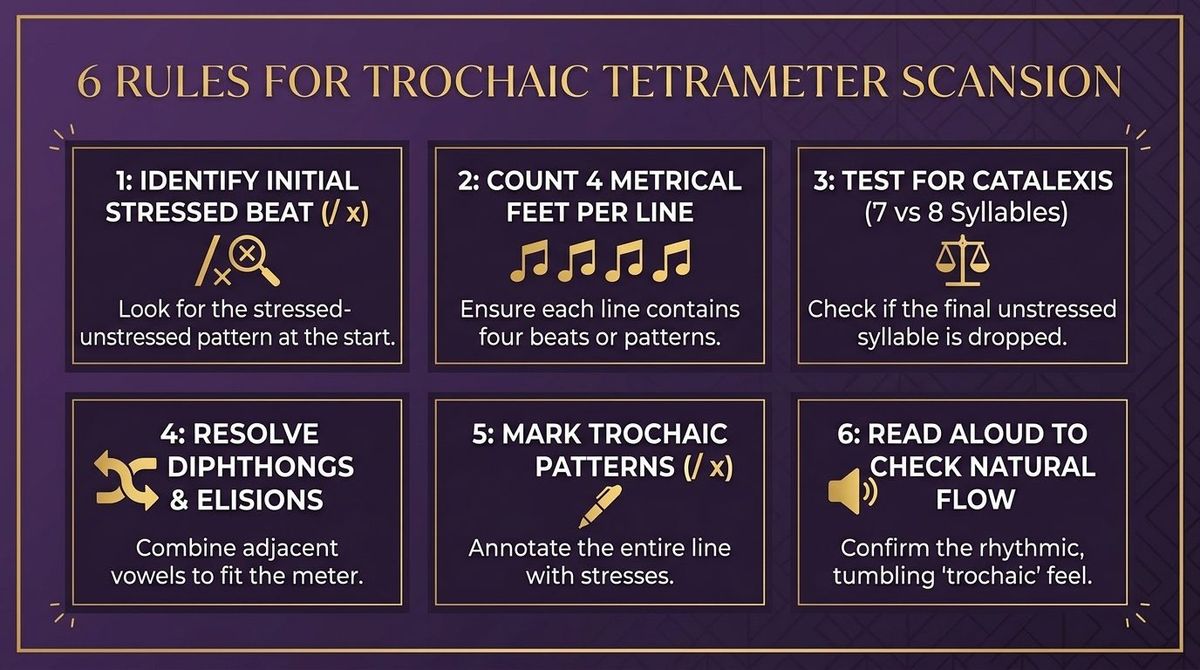
5. Six Step-by-Step Rules to Audit Trochaic Tetrameter Scansion
- Verify the Initial Downbeat (\(/\)): Speak the opening two syllables aloud; if the natural lexical or rhetorical stress falls on Syllable 1 rather than Syllable 2, the line launches on a trochaic or dactylic foot.
- Mark All Polysyllabic Word Stresses First: In English prosody, multi-syllable words (such as "for-ests", "burn-ing", "dou-ble", "shi-ning") have fixed dictionary stress (\(/ \smile\)) that anchors the surrounding monosyllables.
- Count Total Vocalic Nuclei (\(7\text{ vs. }8\)): Count the pronounced vowel sounds (not silent final -e letters). If the line has 4 strong beats and 7 syllables, set \(C = 1\) (catalectic).
- Audit Synizesis & Poetic Elision: Words like "heav'n" (\(1\) syllable), "pow'r" (\(1\) syllable), or "glit-t'ring" (\(2\) syllables) compress unstressed schwa vowels to preserve strict two-syllable trochees.
- Watch for Headless Iambic vs. Catalectic Trochaic Ambiguity: A 7-syllable line scanning \(/ \smile / \smile / \smile /\) is identically described as catalectic trochaic tetrameter (missing its final unstressed syllable) or acephalous (headless) iambic tetrameter (missing its initial unstressed syllable). Determine the label from the dominant meter of the surrounding lines in the poem.
- Test Vocal Breath Placement on Catalectic Rests: When reciting 7-syllable catalectic lines aloud, honour the invisible eighth beat (\([\varnothing]\)) with a quarter-beat pause rather than rushing into the next line.
Frequently Asked Questions
Why is trochaic tetrameter called a "falling meter"?
In classical and English prosody, each trochee moves from a high-energy stressed syllable (\(/\)) down to a lower-energy unstressed syllable (\(\smile\)), creating a "falling" pitch and intensity contour within every foot—the exact opposite of "rising" meters like iambic (\(\smile /\)) and anapestic (\(\smile \smile /\)).
Why does a 7-syllable catalectic trochaic line still count as tetrameter (four feet) if the fourth foot only has one syllable?
Because metrical foot classification counts rhythmic pulses (ictuses/stressed beats) plus any metrical rests. In a 7-syllable catalectic line (\(/ \smile | / \smile | / \smile | / [\varnothing]\)), the fourth stressed syllable still establishes the fourth foot, while a silent metrical rest fills the missing unstressed position.
Is Edgar Allan Poe's "The Raven" written in trochaic tetrameter?
The Raven is written in trochaic octameter (eight trochaic feet per line, \(16\) syllables acatalectic / \(15\) syllables catalectic), which functions mathematically as two trochaic tetrameter halves joined across a strong medial caesura (e.g., "Once up-on a mid-night drear-y, [8] || while I pon-dered, weak and wear-y [8]").
Check Your Line Syllable Counts & Metrical Stress
Writing trochaic verse, hymn lyrics, or a 4/4 chorus hook? Paste your stanza into our free Syllable Counter & Poetry Scansion Calculator to audit per-line syllable totals and catalectic variations in real time.