Voiceover Script Syllables-Per-Second and Speaking Time Formula: 5 Essential Pacing Calculations
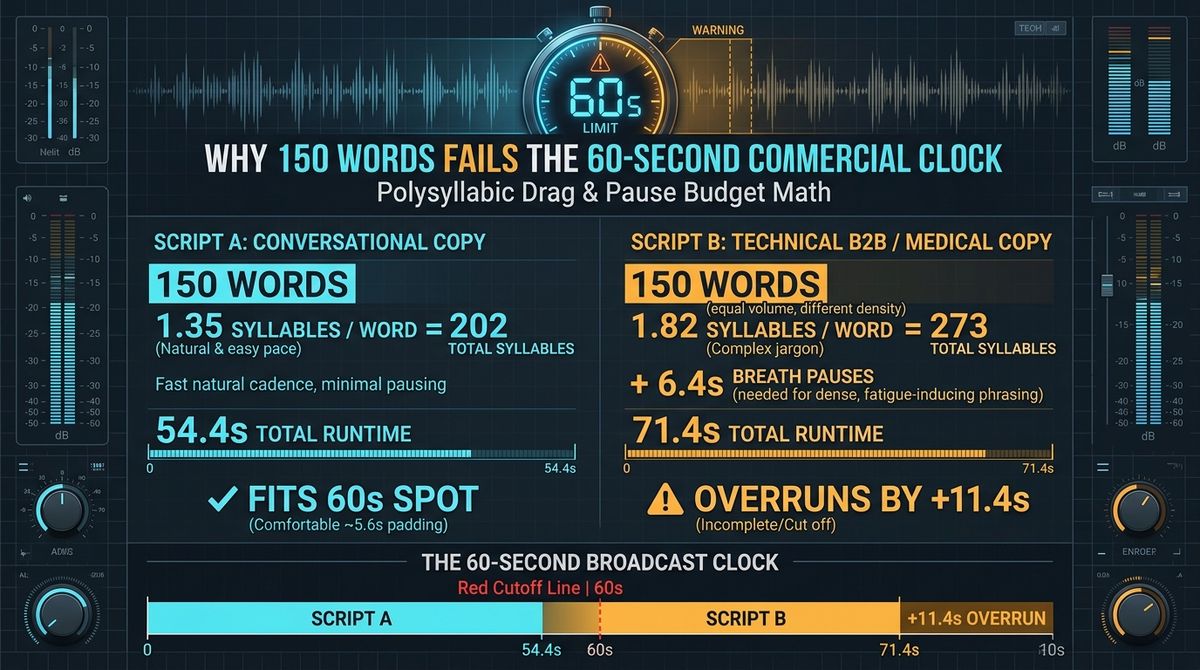
Relying on a generic "150 Words Per Minute" calculator instead of the script syllable count speaking time formula is the number-one reason 30-second commercials, 60-second YouTube Shorts, and B2B explainer voiceovers run 8 to 12 seconds overtime in the recording booth. As professional voice actors frequently point out on r/VoiceActing and in The Voice Realm's script-timing benchmarks, a "word" is an orthographic convention, not an acoustic unit of time. Speaking the 5-syllable word "individually" takes four times longer than speaking the 1-syllable word "now"—yet a standard word-count timer treats both as 1 word! You can audit the exact syllable count, polysyllabic density, and speaking duration of any script instantly using the Syllable Counter & Script Timer and apply the acoustic pacing equations below.
- Why WPM Fails by \(\pm 38\%\): A 75-word script with a syllable density of \(1.25\text{ syll/word}\) contains 94 syllables (~21 seconds), whereas a 75-word B2B technical script at \(2.15\text{ syll/word}\) contains 161 syllables (~37 seconds)—a 16-second timing error on the exact same word count.
- The Master Runtime Formula (\(T_{\text{total}}\)): \(T_{\text{total}} = \frac{N_{\text{syll}}}{\text{SPS}_{\text{net}}} + \left(N_{\text{comma}} \times 0.25\text{ s}\right) + \left(N_{\text{period}} \times 0.55\text{ s}\right)\).
- Conversational Articulation Rate (\(\text{SPS}_{\text{net}}\)): Natural broadcast English averages \(4.2\text{ to }4.6\text{ Syllables Per Second}\) of active articulation (excluding breath pauses).
- The 30-Second Commercial Ceiling: Never exceed 105 to 115 total syllables (roughly 65–75 conversational words + 6 punctuation pauses) for a 30-second broadcast spot.
The WPM Fallacy Exposed: Two 75-word scripts diverge from 21.3 seconds (94 syllables, consumer copy) to 37.8 seconds (161 syllables, B2B medical/SaaS copy) at the exact same 4.4 SPS vocal articulation rate. 1. Why Words Per Minute (WPM) Is Mathematically Broken for Script Timing
Every copywriter has been taught the classic broadcast rule of thumb: "150 Words Per Minute = 2.5 words per second, so a 30-second commercial is 75 words and a 60-second video is 150 words." That rule only works when your script's Syllable Density (\(D_{\text{syll}} = \frac{N_{\text{syll}}}{N_{\text{words}}}\)) happens to equal the standard conversational English average of exactly \(1.45\text{ syllables per word}\).
In real production scripts, syllable density swings wildly by genre:
- Punchy Direct-Response / TikTok Hook Copy (\(D_{\text{syll}} = 1.18\text{ to }1.30\)): Built from Anglo-Saxon monosyllables ("Stop paying high fees on every sale you make" = 11 words, 12 syllables, \(D_{\text{syll}} = 1.09\)).
- Corporate SaaS, Finance, or Medical Explainer Copy (\(D_{\text{syll}} = 1.85\text{ to }2.30\)): Packed with Latinate polysyllables ("Automated infrastructure observability eliminates organizational vulnerabilities" = 6 words, 26 syllables, \(D_{\text{syll}} = 4.33\)).
Notice that the 6-word corporate sentence contains more than twice as many syllables (26 vs 12) as the 11-word direct-response sentence! If a voice actor attempts to read a 75-word corporate script containing 158 syllables inside a 30-second TV or YouTube ad slot, they are forced to speak at 6.2 syllables per second—sounding like a sped-up legal disclaimer at the end of a car commercial (r/VoiceActing Pacing Audit).
2. Formula 1: The Master Voiceover Runtime (\(T_{\text{total}}\)) Equation
In acoustic phonetics, total script duration (\(T_{\text{total}}\), in seconds) is the sum of two independent physical components: Active Articulation Time (\(T_{\text{artic}}\)) and Prosodic Pause Time (\(T_{\text{pause}}\)). After pasting your script into CountSyllable.com to obtain your exact syllable count (\(N_{\text{syll}}\)), comma/clause count (\(N_{\text{comma}}\)), and sentence/period count (\(N_{\text{period}}\)), calculate exact studio runtime with:
- \(\text{SPS}_{\text{artic}}\) (Net Articulation Rate in Syllables Per Second): The speed at which the human vocal tract produces syllables while actively speaking:
- Calm / Luxury Brand / Audiobook Narration: \(3.8\text{ to }4.1\text{ SPS}\)
- Natural Conversational / YouTube / Podcast: \(4.3\text{ to }4.6\text{ SPS}\)
- High-Energy YouTube Short / Upbeat Promo: \(4.8\text{ to }5.2\text{ SPS}\)
- \(\tau_{\text{comma}} = 0.25\text{ seconds}\) (250 ms): The natural prosodic phrasing pause at commas, semicolons, and em-dashes.
- \(\tau_{\text{period}} = 0.55\text{ seconds}\) (550 ms): The diaphragm inhalation breath and dramatic beat required at the end of each complete sentence (
.,?,!). - \(N_{\text{digits}} \times \tau_{\text{num}}\) (The Written-Digit Trap): Copywriters frequently type
2026or$1,495as 1 word in Microsoft Word—yet spoken aloud, *"two thousand twenty-six"* is 6 syllables (+1.35 seconds) and *"fourteen hundred ninety-five dollars"* is 9 syllables (+2.05 seconds)! Always expand numbers and URLs into spelled-out words before counting syllables.
3. Complete Script Format & Syllable Budget Table (15s, 30s, 60s, and 5-Min)
Use the verified broadcast production table below to set your maximum syllable and punctuation budget before sending any script to a voice actor or AI text-to-speech engine:
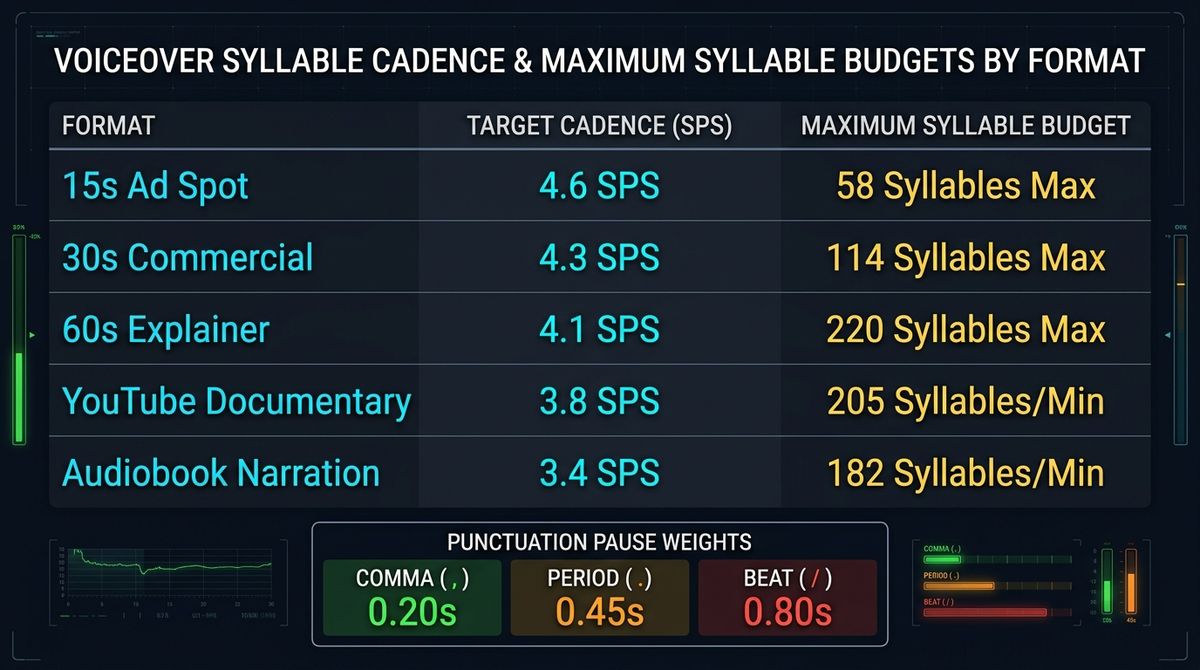
| Video / Audio Format | Target Duration | Target Articulation (\(\text{SPS}_{\text{artic}}\)) | Pause Allowance (\(T_{\text{pause}}\)) | Max Syllable Budget (\(N_{\text{syll},\text{max}}\)) | Equiv. Word Count (Conv. vs Technical) |
|---|---|---|---|---|---|
| 15-Sec Pre-Roll / Bumper Ad | 15.0 sec | 4.6 SPS (Upbeat) | 2.2 sec (3 sentences) | 54 – 58 syllables | 42 conv. words / 29 tech words |
| 30-Sec TV / Radio / Podcast Ad | 30.0 sec | 4.4 SPS (Natural) | 4.8 sec (6 sentences) | 106 – 112 syllables | 75 conv. words / 54 tech words |
| 60-Sec YouTube Short / Reel | 60.0 sec | 4.8 SPS (Dynamic) | 8.5 sec (11 sentences) | 240 – 250 syllables | 168 conv. words / 122 tech words |
| 90-Sec B2B SaaS Explainer | 90.0 sec | 4.2 SPS (Clear) | 14.5 sec (16 sentences) | 310 – 325 syllables | 220 conv. words / 158 tech words |
| 5-Min Educational YouTube Video | 300.0 sec | 4.4 SPS (Steady) | 48.0 sec (55 sentences) | 1,080 – 1,120 syllables | 750 conv. words / 540 tech words |
Look closely at the 30-Second Ad row: while 75 conversational words (at \(1.45\text{ syll/word}\)) equals 109 syllables and fits a 30-second spot cleanly, a technical B2B script with \(2.05\text{ syll/word}\) hits that exact same 110-syllable ceiling at just 54 words!
30-Second Commercial Acoustic Budget: 25.2 seconds of active syllable articulation (111 syllables at 4.4 SPS) + 4.8 seconds of prosodic breathing and emphasis beats = 30.0 seconds exact lock. 4. Formula 2: Converting Between WPM and Syllables Per Second (SPS)
When working with video editors, teleprompter apps, or AI voice synthesis platforms (such as ElevenLabs or Descript) that display pacing in Words Per Minute (\(\text{WPM}\)), you can convert between \(\text{WPM}\) and effective Syllables Per Second (\(\text{SPS}_{\text{eff}}\), inclusive of pauses) using the Syllable-Density Conversion Identity:
For example, if you want your narrator to maintain a warm, authoritative effective delivery pace of \(\text{SPS}_{\text{eff}} = 3.70\text{ syllables/sec}\) (inclusive of pauses) on a dense cybersecurity script whose syllable density is \(D_{\text{syll}} = 1.92\text{ syllables/word}\), you must set your teleprompter speed to:
If you left the teleprompter at the default 150 WPM setting on a \(1.92\text{ syll/word}\) script, the speaker would be forced to articulate at \(4.80\text{ effective SPS}\) (\(5.6+\text{ net articulation SPS}\)), tripping over consonant clusters and running out of breath.
5. Worked Calculation: Auditing a 30-Second Commercial Script Before Studio Booking
Suppose a client hands you a 72-word B2B software script for a strict 30.0-second broadcast spot. You expand all numerals and URLs ("24/7" → *"twenty-four seven"*, "App.io" → *"app dot I O"*) and run the text through CountSyllable.com, revealing:
- Word Count (\(N_{\text{words}}\)): 72 words (looks safe under the naive "75-word" myth!)
- True Syllable Count (\(N_{\text{syll}}\)): 138 syllables (\(D_{\text{syll}} = 1.92\text{ syll/word}\))
- Punctuation Count: 5 commas (\(N_{\text{comma}} = 5\)) and 6 periods (\(N_{\text{period}} = 6\))
- Target Conversational Articulation Rate (\(\text{SPS}_{\text{artic}}\)): \(4.4\text{ syllables/sec}\)
Step 1 — Calculate Actual Studio Runtime (\(T_{\text{total}}\)):
Even though the script is only 72 words long, it will run 5.91 seconds overtime (35.91s) in the booth!
Step 2 — Calculate Required Syllable Reduction (\(\Delta N_{\text{syll}}\)) to Hit 29.5 Seconds:
By replacing 14 Latinate 3-to-4-syllable words with crisp 1-to-2-syllable synonyms (e.g., swapping "additionally" [5] for "plus" [1], "utilization" [5] for "use" [1], and "immediately" [5] for "now" [1]), you trim 28 syllables without cutting a single product benefit—bringing the script to 110 syllables and locking in a 29.55-second studio read on Take 1.
Frequently Asked Questions
How many syllables are in a 30-second commercial script?
A natural 30-second commercial voiceover contains 105 to 115 total syllables (including spelled-out numbers, brand names, and URLs), paired with 5 to 6 sentence pauses totaling roughly 4.5 seconds. For high-energy promo reads, the hard ceiling is 125 syllables.
Why do phone numbers and website URLs ruin voiceover script timing?
Word processors count 1-800-555-0199 as 1 word and CountSyllable.com as 1 word. However, spoken aloud with clear broadcast cadence, a 10-digit phone number contains 11 to 14 syllables plus three 200ms grouping pauses (~4.2 seconds total), and a .com URL adds 4 to 7 syllables plus a pause before the call-to-action.
What is the ideal syllables-per-second rate for YouTube Shorts and TikTok hooks?
High-retention short-form vertical videos perform best at an active articulation pace of 4.8 to 5.2 Syllables Per Second during the opening 3-second hook (roughly 14 to 15 crisp syllables in the first 3 seconds), followed by 4.5 SPS in the main body.
Conclusion: Time Your Script by Syllable Count Before You Hit Record
Whether you are hiring a SAG-AFTRA voice actor, reading a teleprompter for YouTube, or generating an AI voiceover track, syllable count is the true clock of spoken language. Paste your draft into the CountSyllable.com Script & Syllable Analyzer right now to check your exact syllable count, polysyllabic word density, and predicted speaking runtime in seconds.